Spring, month 3 of 12
March
Fix a Leak Week, the clocks change, and the sump pump gets its first test of the year.
EPA WaterSense Fix a Leak Week (March); daylight saving time begins the second Sunday of March
March is the hinge of the year. The EPA runs Fix a Leak Week, daylight saving time arrives with its battery reminder, snowmelt and spring rain test the sump pump, and it is the right moment to book the air conditioner's check-up before the first hot week fills every contractor's calendar.
Fix the dripping faucet (Fix a Leak Week)
A faucet dripping once a second wastes more than 3,000 gallons a year, which is why the EPA gives leaks a week every March. On a two-handle faucet the drip almost always comes from a worn rubber washer or a worn brass seat; the City of Rio Rancho's guide says to run a finger along the seat rim and replace it with a seat wrench if it feels pitted. Washers are inexpensive and take minutes once the water is shut off at the stop valve under the fixture and the faucet opened to confirm it is off. Take the old parts to the store, or match the stem by number. Read how a compression faucet works first; it shows which part does what.
A shower that drips with the handle off needs a cartridge
Single-handle tub and shower valves do not use washers. Moen's own troubleshooting says a shower that keeps running or dripping with the handle in the off position needs its cartridge replaced, and that if the water pressure drops as you turn from cold toward hot, the cartridge is the suspect there too. Before you buy one, rule out a mis-set temperature limit stop, which only restricts how far the handle turns. Read how a pressure-balance shower valve works.
Change the clocks, change the alarm batteries
Daylight saving time begins at 2 a.m. on the second Sunday of March (Hawaii, most of Arizona and the territories sit it out). The CDC ties the clock change to checking carbon monoxide detector batteries each spring and fall, and CPSC has run the same reminder for smoke alarms. USFA's rule for smoke alarms is batteries at least once a year and a whole new alarm every 10 years. For CO alarms, follow the date or end-of-life signal on the unit: the CDC says every 5 years or per the manufacturer.
Test the sump pump before snowmelt and spring rain
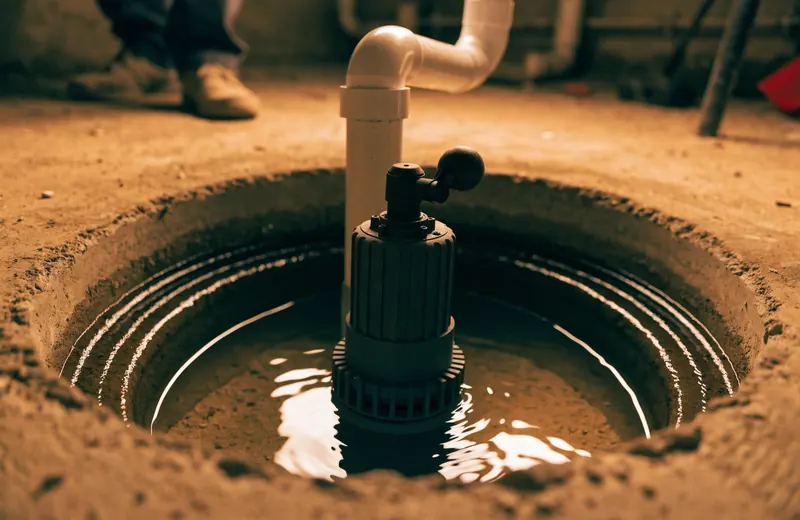
NDSU Extension's spring routine: pour water into the pit until the float turns the pump on, make sure it turns on and off at least twice, and check that the discharge pipe outside is not plugged and sends water away from the house. FEMA notes that basements flood when the primary pump stops, when the power goes out, or when heavy rain overloads it, and suggests a battery-operated backup pump for outages.
Book the air conditioner's spring check-up
ENERGY STAR's advice is to check the cooling system in spring and the heating system in fall, because contractors get busy once summer and winter arrive. A proper cooling tune-up includes checking the thermostat, tightening electrical connections, lubricating moving parts, inspecting the condensate drain, checking system controls, cleaning the evaporator and condenser coils, and checking the refrigerant level. Read how a central air conditioner and a heat pump move heat.
Walk the outside of the house after winter
The University of Georgia's home checklist puts gutters and downspouts in both spring and fall columns and says downspouts should discharge water 2 to 3 feet from the house. FEMA's flooding guidance: keep gutters, downspouts and splash pads clear so rainwater flows away, and improve grading so the lot drains away from the foundation. The EPA's mold guide makes the same point from the inside: make sure the ground slopes away from the foundation.
Every month, all year
- Look at the furnace or air handler filter. Inspect, clean or change it once a month; during cooling season DOE says every month or two. How a filter works.
- Press the test button on every smoke alarm and carbon monoxide alarm. Both get a monthly test.
- Press TEST, then RESET, on each GFCI outlet, and the TEST button on any AFCI breakers in the panel. Monthly for both. If one will not reset or trip, that is an electrician call.
- Run water into any sink, tub or floor drain that does not get used. A trap only blocks sewer gas while it holds water, and once a month is the usual rule.
The Monthly Almanac, by email
One email at the start of each month with that month's checklist for your region, and nothing else. Next month's list, in your inbox before the month starts.
Unsubscribe in any email. We never sell or share the list. Privacy.
References
- Fix a Leak Week. U.S. EPA WaterSense. https://www.epa.gov/watersense/fix-leak-week
- Faucet Leaks: Detect and Fix Leaks. City of Rio Rancho, New Mexico. https://rrnm.gov/DocumentCenter/View/63056
- Home Water Conservation (FSA9520). University of Arkansas Cooperative Extension Service. https://www.uaex.uada.edu/publications/pdf/FSA-9520.pdf
- Shower Faucet: Leaking, PosiTemp Valve. Moen. https://solutions.moen.com/Article_Library/Shower_Faucet:_Leaking-_PosiTemp_Valve
- Water temperature is not HOT enough on tub shower units. Moen. https://solutions.moen.com/FAQ's/FAQ's-Troubleshooting/Bathroom/Water_temperature_is_not_HOT_enough_on_tub_shower_units
- Daylight Saving Time Rules. National Institute of Standards and Technology. https://www.nist.gov/pml/time-and-frequency-division/popular-links/daylight-saving-time-dst
- Carbon Monoxide Poisoning Basics. Centers for Disease Control and Prevention. https://www.cdc.gov/carbon-monoxide/about/index.html
- Change your Clocks, Change your Batteries!. U.S. Consumer Product Safety Commission. https://www.cpsc.gov/Newsroom/News-Releases/2018/Change-your-Clocks-Change-your-Batteries
- Smoke Alarms. U.S. Fire Administration (FEMA). https://www.usfa.fema.gov/prevention/home-fires/prepare-for-fire/smoke-alarms/
- Now is the Time to Check Your Sump Pump (March 2022). North Dakota State University Extension. https://www.ag.ndsu.edu/news/newsreleases/2022/march/now-is-the-time-to-check-your-sump-pump
- Mitigation and Basement Flooding. FEMA. https://www.fema.gov/pdf/hazard/flood/2010/1935/Basement_Flood_Mitigation.pdf
- Protect Your Home from Future Flooding (2018). FEMA. https://www.fema.gov/print/txt/node/332613
- Maintenance Checklist. ENERGY STAR. https://www.energystar.gov/saveathome/heating-cooling/maintenance-checklist
- Home Maintenance Checklist (Circular 1082, reviewed 2021). University of Georgia Cooperative Extension. https://www.fcs.uga.edu/docs/HomeMaintChecklist_update_6.21.pdf
- A Brief Guide to Mold, Moisture and Your Home. U.S. Environmental Protection Agency. https://www.epa.gov/mold/brief-guide-mold-moisture-and-your-home
- Maintaining Your Air Conditioner. U.S. Department of Energy, Energy Saver. https://www.energy.gov/energysaver/maintaining-your-air-conditioner
- CPSC Warns of Generator, Carbon Monoxide and Fire Hazards Ahead of Hurricane Season (May 27, 2026). U.S. Consumer Product Safety Commission. https://www.cpsc.gov/Newsroom/News-Releases/2026/CPSC-Warns-of-Generator-Carbon-Monoxide-and-Fire-Hazards-Ahead-of-Hurricane-Season
- Ground Fault Circuit Interrupters (GFCI). Electrical Safety Foundation International. https://www.esfi.org/ground-fault-circuit-interrupters-gfci/
- How to Test an AFCI. Electrical Safety Foundation International. https://www.esfi.org/how-to-test-an-afci/
- Funky Smell? It Might Be a Dry Drain. Princeton University Office of Environmental Health and Safety. https://ehs.princeton.edu/news/keep-drain-traps-drying-out
Every fact and number on this page comes from one of the sources above, read during the writing of this page. Codes and standards vary by jurisdiction and edition; your local code and your equipment's manual control.