Fall, month 10 of 12
October
Fire Prevention Week, the winterizing of outdoor water, and gutters after the leaves fall.
NFPA Fire Prevention Week, October 4 to 10, 2026
October carries the oldest public safety observance in the country, Fire Prevention Week, and the plumbing job that saves more houses than any other: shutting down the outdoor water before the first hard freeze. In the North it also means the ice-dam fix, done while the attic is still dry.
Fire Prevention Week: alarms on every level, inside and outside bedrooms
Fire Prevention Week is observed during the week of October 9 to mark the Great Chicago Fire of 1871; President Coolidge made it a national observance in 1925, and NFPA's 2026 week runs October 4 to 10. USFA's smoke alarm rules: put alarms inside and outside each bedroom and sleeping area and on every level of the home; choose interconnected alarms so when one sounds they all sound; mount them on the ceiling or high on the wall; test monthly; replace batteries at least yearly; and replace the whole alarm every 10 years. CPSC: carbon monoxide alarms with battery backup on every level and outside sleeping areas.
Winterize the outdoor faucets
The American Red Cross list: remove, drain and store hoses used outdoors; close the inside valves supplying outdoor hose bibbs, then open the outside faucet to let it drain; and drain the sprinkler and pool supply lines following the installer's directions. Even a frost-free sillcock, whose shutoff sits inside the heated wall, gets its hose removed; the Red Cross list starts there. What a hose bibb is.
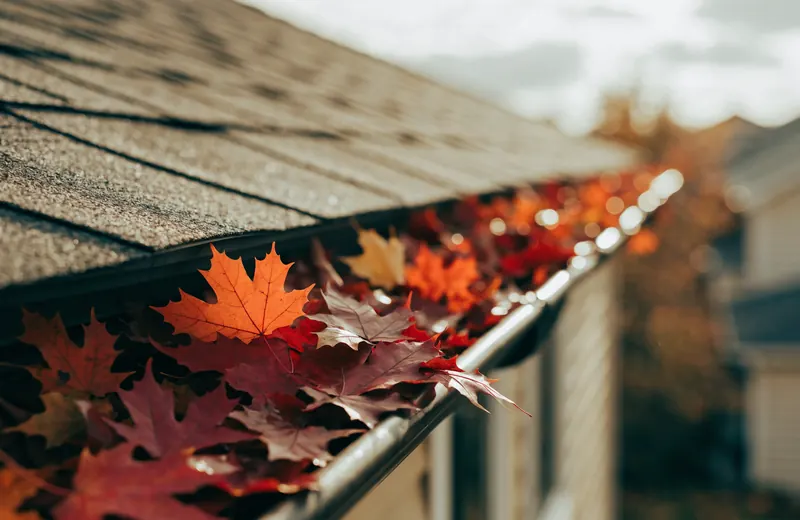
Clean the gutters after the leaves come down
UGA's fall checklist: clean gutters and downspouts and make sure they discharge 2 to 3 feet from the house. NFPA's wildfire guidance adds a second reason to keep roofs and gutters free of leaves and debris: embers.
Insulate the pipes in unheated spaces
The Red Cross: pipes in unheated areas (basements, crawl spaces, attics, garages, under kitchen cabinets) and along poorly insulated exterior walls freeze most often. Insulate them with pipe sleeves. Where a sleeve is not enough, the Red Cross allows UL-listed heat tape, and CPSC's rules for it are strict because heat tapes start fires: buy a tape certified to the safety standard, plug it into a GFCI-protected three-prong outlet, apply it directly on the pipe following the maker's instructions (never on top of insulation), never wrap it over itself, do not cover it with insulation unless the maker says you can, inspect it every fall for charring, cuts or discoloration at the plug, and replace any uncertified tape more than 3 years old. Then seal the air leaks that let cold air reach the pipes.
Air seal and insulate the attic while it is dry
If you had ice dams last winter, the University of Minnesota's lasting fix comes in two steps: first make the ceiling airtight so no warm, moist air can flow from the house into the attic, then add insulation. Minnesota's energy office names the usual leaks: around plumbing vents, wiring and chimneys. For most houses this is contractor work: ENERGY STAR's own do-it-yourself guide says to hire a professional when the attic has a history of ice dams, old wiring or many recessed lights, and the University of Minnesota points to weatherization contractors, who can test the house with a blower door and find the leaks with an infrared camera. If you do go up yourself, walk only on the joists, keep insulation at least 3 inches from any recessed light that is not marked IC-rated, keep it 1 inch from metal flues and 2 inches from masonry chimneys, do not disturb loose, pebbly vermiculite insulation (it may contain asbestos), and stop if you find knob-and-tube wiring, which is a fire hazard under insulation. DOE's Building America guidance adds passive roof ventilation (soffit and ridge vents, not a powered attic fan) in cold climates to keep the roof deck cold. October is dry enough for the work and early enough to matter.
Before the first fire or the first furnace run
USFA: heating fires are the second leading cause of home fires, and heating equipment and chimneys should be cleaned and inspected each year by a professional. Keep anything that can burn at least 3 feet from fireplaces, wood stoves, radiators and space heaters. If the chimney inspection in September has not happened, do it before the first fire.
Every month, all year
- Look at the furnace or air handler filter. Inspect, clean or change it once a month; during cooling season DOE says every month or two. How a filter works.
- Press the test button on every smoke alarm and carbon monoxide alarm. Both get a monthly test.
- Press TEST, then RESET, on each GFCI outlet, and the TEST button on any AFCI breakers in the panel. Monthly for both. If one will not reset or trip, that is an electrician call.
- Run water into any sink, tub or floor drain that does not get used. A trap only blocks sewer gas while it holds water, and once a month is the usual rule.
Previous: SeptemberNext: November
The Monthly Almanac, by email
One email at the start of each month with that month's checklist for your region, and nothing else. Next month's list, in your inbox before the month starts.
Unsubscribe in any email. We never sell or share the list. Privacy.
References
- Fire Prevention Week. U.S. Census Bureau. https://www.census.gov/newsroom/stories/fire-prevention-week.html
- Celebrate NFPA Fire Prevention Week (FPW), October 4-10. National Fire Protection Association. https://www.nfpa.org/events/fire-prevention-week
- Smoke Alarms. U.S. Fire Administration (FEMA). https://www.usfa.fema.gov/prevention/home-fires/prepare-for-fire/smoke-alarms/
- Carbon Monoxide Information Center. U.S. Consumer Product Safety Commission. https://www.cpsc.gov/Safety-Education/Safety-Education-Centers/Carbon-Monoxide-Information-Center
- Preventing and Thawing Frozen Pipes. American Red Cross. https://www.redcross.org/get-help/how-to-prepare-for-emergencies/types-of-emergencies/winter-storm/frozen-pipes.html
- What is a Hose Bibb?. PRIER. https://www.prier.com/blog/what-is-a-hose-bibb/
- How a Standard Frost-Proof Faucet Works. Woodford Manufacturing. https://www.woodfordmfg.com/woodford/HowAFaucet/How%20a%20Standard%20Frost-Proof%20Faucet%20Works.pdf
- Home Maintenance Checklist (Circular 1082, reviewed 2021). University of Georgia Cooperative Extension. https://www.fcs.uga.edu/docs/HomeMaintChecklist_update_6.21.pdf
- Defensible Space for Protection Against Wildfires. DOE Building America Solution Center (PNNL), citing NFPA. https://basc.pnnl.gov/resource-guides/defensible-space-protection-against-wildfires?disaster_resistance=145726
- CPSC Re-Issues Heat Tape Guidelines. U.S. Consumer Product Safety Commission. https://www.cpsc.gov/Newsroom/News-Releases/1996/CPSC-Re-Issues-Heat-Tape-Guidelines-In-Wake-Of-Zoo-Fire
- Dealing with and preventing ice dams. University of Minnesota Extension. https://extension.umn.edu/protecting-home-rain-and-ice/dealing-and-preventing-ice-dams
- Home Energy Guide: Attic air leaks = ice dams. Minnesota Department of Commerce. https://mn.gov/commerce-stat/pdfs/ice-dams.pdf
- Do-It-Yourself Guide to Sealing and Insulating with ENERGY STAR. ENERGY STAR. https://www.energystar.gov/ia/partners/manuf_res/salestraining_res/HS_diy_guide.pdf
- Heating Fire Safety. U.S. Fire Administration (FEMA). https://www.usfa.fema.gov/prevention/home-fires/prevent-fires/heating/
- Maintenance Checklist. ENERGY STAR. https://www.energystar.gov/saveathome/heating-cooling/maintenance-checklist
- Maintaining Your Air Conditioner. U.S. Department of Energy, Energy Saver. https://www.energy.gov/energysaver/maintaining-your-air-conditioner
- CPSC Warns of Generator, Carbon Monoxide and Fire Hazards Ahead of Hurricane Season (May 27, 2026). U.S. Consumer Product Safety Commission. https://www.cpsc.gov/Newsroom/News-Releases/2026/CPSC-Warns-of-Generator-Carbon-Monoxide-and-Fire-Hazards-Ahead-of-Hurricane-Season
- Ground Fault Circuit Interrupters (GFCI). Electrical Safety Foundation International. https://www.esfi.org/ground-fault-circuit-interrupters-gfci/
- How to Test an AFCI. Electrical Safety Foundation International. https://www.esfi.org/how-to-test-an-afci/
- Funky Smell? It Might Be a Dry Drain. Princeton University Office of Environmental Health and Safety. https://ehs.princeton.edu/news/keep-drain-traps-drying-out
Every fact and number on this page comes from one of the sources above, read during the writing of this page. Codes and standards vary by jurisdiction and edition; your local code and your equipment's manual control.