How it works: HVAC
How a furnace and AC filter works
The cheapest part in the system, and the one behind most of its problems
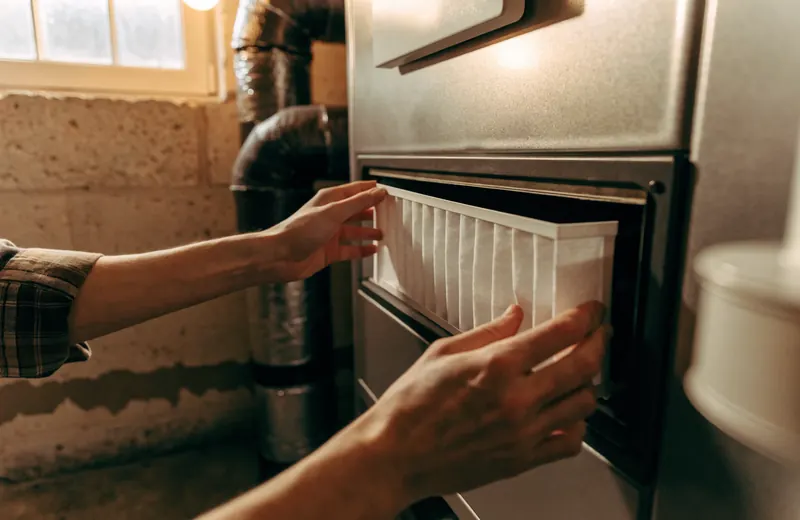
The filter in a forced-air system is a sheet of pleated paper or fiber in a cardboard frame, and it is the part of the system a homeowner touches most. It is also the part behind a surprising share of service calls: a furnace that overheats and short-cycles, a coil that ices, a blower that cannot keep up. This page covers where it sits, what the ratings mean, and how to choose and change it.
Where it sits
A forced-air system is a loop of air. The blower pushes heated or cooled air out through the supply ducts to the registers in each room. The return ducts pick up inside air for reconditioning, drawing it through a changeable filter to the air handler. The filter traps dust, pollen and debris before they can enter the furnace blower and the heating or cooling coils. In most houses the filter is in a slot where the return duct meets the furnace or air handler; in some it is behind a large return grille on a wall or ceiling.
The order matters: the filter is upstream of everything expensive. Its first job is to keep the blower wheel and the evaporator coil clean, because a dirty coil cannot absorb heat and a dirty blower cannot move air. Cleaner room air is the second benefit.
What MERV means
Filters are rated by MERV, Minimum Efficiency Reporting Value, which reports a filter’s ability to capture particles between 0.3 and 10 microns. The higher the MERV, the better the filter is at trapping particles of a given size. The standard scale runs to 16; filters with a MERV of 13 and above must demonstrate at least 50 percent removal efficiency for the smallest particles tested.
Two things are not on that scale. HEPA filters are a separate category, a type of pleated mechanical filter common in portable air cleaners rather than in furnace slots. And a filter only cleans air while the system is running; the EPA notes that furnace and HVAC filters work only when the system is operating, which during heating and cooling seasons is usually less than 25 percent of the time. If room air quality is the goal, the filter is a contributor, not the whole answer.
The airflow tradeoff
A denser filter catches more and resists airflow more. The EPA’s advice splits the difference: choose a filter with at least a MERV 13 rating, or as high a rating as your system fan and filter slot can accommodate, and to be certain a filter will work with your system, consult an HVAC technician. The EPA also says most furnaces and HVAC systems can accommodate a MERV 13 filter without creating equipment problems, provided the filter is replaced frequently.
That last clause is the whole trade. A high-MERV filter that is changed on time is fine. A high-MERV filter left in for a season loads up, starves the system of air, and does the damage below.
What a dirty filter does
ENERGY STAR: a dirty filter can increase energy costs and damage your equipment, leading to early failure. DOE: replacing a dirty, clogged filter with a clean one can lower an air conditioner’s energy consumption by 5 to 15 percent. Trane’s furnace troubleshooting draws the line to the symptom you notice: clogged or dirty filters disrupt airflow, causing the furnace to overheat and shut down on its limit switch before a heating cycle is done. That is the furnace that runs for a few minutes, stops, waits, and runs again, never quite warming the house.
How often
The guidance differs by source, and the right answer is the one printed on your equipment and filter:
- ENERGY STAR: inspect, clean or change the filter once a month in your central air conditioner, furnace or heat pump.
- DOE: clean or replace the air conditioner’s filter every month or two during the cooling season.
- Carrier’s owner’s manual: check the furnace filter every 4 weeks and clean or replace it if necessary.
- The EPA’s general rule: all filters require periodic replacement; follow the manufacturer’s recommendations.
Dust, pets, construction nearby and a house that runs the fan continuously all push toward the short end. The Almanac’s standing monthly item is to look at it; looking costs nothing.
Changing it
Turn off the power to the furnace at its switch (the light-switch-style box on or beside the furnace) or at its breaker; Carrier’s owner’s manual makes that step one of filter service. The blower door switch is a backup, not the shutoff. Slide the old filter out and note the arrow on its frame: it points in the direction of airflow, toward the blower, and the new one goes in the same way. Match the size printed on the frame exactly; a filter that is too small lets air bypass it and a filter that is forced in bends and gaps. Write the date on the new frame’s edge. If the slot has no cover, a strip of foil tape over the opening keeps the blower from pulling unfiltered basement air around the filter.
If you cannot find a filter at all, check behind the return grilles in the living space, and check whether the system has a media cabinet (a wide box holding a thick filter) rather than a thin slot.
Related
- Almanac: every month (standing list), June, cooling season, September, start the heating season fresh
- How a gas furnace cycles and how an air conditioner moves heat, the equipment the filter protects
- Glossary: MERV, return air, plenum, blower
References
- Energy Efficient Homes: The Duct System (FCS3263). University of Florida IFAS Extension. https://ask.ifas.ufl.edu/publication/FY1024
- Furnace Parts: Understanding the Components of a Furnace. Carrier. https://www.carrier.com/us/en/residential/hvac-resources/furnaces/furnace-parts/
- What is a MERV rating?. U.S. Environmental Protection Agency. https://www.epa.gov/indoor-air-quality-iaq/what-merv-rating
- Guide to Air Cleaners in the Home. U.S. Environmental Protection Agency. https://www.epa.gov/indoor-air-quality-iaq/guide-air-cleaners-home
- Maintenance Checklist. ENERGY STAR. https://www.energystar.gov/saveathome/heating-cooling/maintenance-checklist
- Owner's Manual, Induced Combustion Gas Furnace (OM58-132). Carrier. https://www.shareddocs.com/hvac/docs/1009/Public/01/OM58-132.pdf
- Maintaining Your Air Conditioner. U.S. Department of Energy, Energy Saver. https://www.energy.gov/energysaver/maintaining-your-air-conditioner
- Furnace Short Cycling: Causes and Solutions. Trane. https://www.trane.com/residential/en/resources/troubleshooting/gas-furnaces/furnace-short-cycling/
Every fact and number on this page comes from one of the sources above, read during the writing of this page. Codes and standards vary by jurisdiction and edition; your local code and your equipment's manual control.