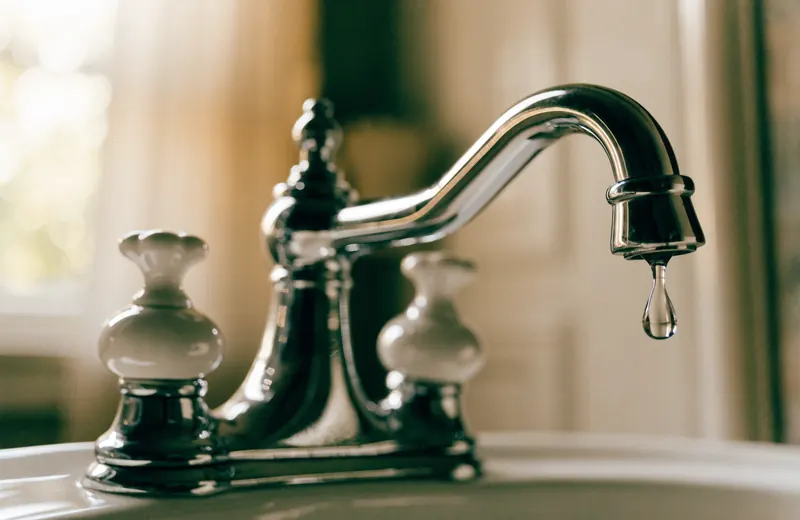
A compression faucet is the oldest faucet design still in service, and the one many older houses still have at the laundry sink, the tub and the outdoor spigot. It always has two handles, one for hot and one for cold. Each handle turns a threaded stem, and the stem does one thing: it presses a rubber washer down onto a brass seat to stop the water, and lifts it off to let water through. Everything else on the faucet is there to keep that one seal working or to keep water from escaping around it.
The parts, from the handle down
The handle and the broach. The handle grips the stem through a shaped opening called the broach. The stem should fit snugly inside it. This is why replacement stems are sold by broach shape and point count as well as by length: a stem that fits the body but spins inside the handle is no use.
The stem. The threaded brass (or sometimes plastic) shaft that starts, stops and regulates the flow. When you turn the handle on, the stem rotates, its threads cause it to rise, and the washer on its tip moves away from the seat so water can flow. Turn it off and the threads drive the washer back down.
The packing. Where the stem leaves the faucet body it passes through packing: a packing washer, an O-ring or a wound packing string, squeezed by the packing nut. The packing keeps water from leaking out around the handle. It is a separate seal from the washer, and it fails separately.
The washer. The rubber stopper fastened to the bottom of the stem. Inserted into the seat it blocks the water; raised, it lets the water flow. Every time you shut the faucet, the washer is crushed against brass. That is why it wears out.
The seat. A brass (occasionally rubber) ring in the faucet body that gives the washer a smooth surface to seal against. Many seats unscrew from the body with a seat wrench; a seat with a square or hexagonal hole, or a screwdriver slot, is a replaceable one.
Where the drip comes from
Two different leaks come from two different seals, and the fix depends on which one you have.
A drip from the spout with the handles off means the washer is no longer sealing against the seat. Washers wear out through daily use. Replacing one is a few minutes’ work with the water shut off at the fixture’s stop valve, and the University of Arkansas extension service makes the point that washers are inexpensive and take only a few minutes to replace. One faucet dripping once a second wastes more than 3,000 gallons a year, which is why the EPA gives leaks their own week every March.
A leak at the handle when the water is running means the packing has worn, not the washer. Replace the packing washer or packing string, or tighten the packing nut a quarter turn, and the handle leak stops.
A drip that comes back a month after a new washer usually means the seat is the problem, not the washer. Friction from the stem gouges the seat over time, and hard water adds mineral buildup, so a fresh washer cannot seal on a rough seat. The check is simple: run a fingertip around the rim of the seat. If it feels pitted or rough, unscrew it with a seat wrench and install a new one.
Doing the job
Shut the water off at the stop valve under the fixture; a stop lets you shut off one sink or toilet without disrupting the rest of the house. Pull the handle, back out the stem with a wrench on the packing nut, and take the stem and washer with you to the store. The City of Rio Rancho’s homeowner guide puts it plainly: take the old parts with you when you go to buy replacements. Matching by eye is easier than matching by memory, and stems from different makers are not interchangeable even when they look alike.
If you would rather match by number, stems and seats are catalogued by brand and part number. The Stems and Cartridges index identifies a stem by its length, broach and brand if you have the old one in hand.
When you reassemble, a new seat goes in before the stem, and the stem goes back with the handle in the off position so the washer seats gently. A seat wrench is the one special tool the job needs.
When it is time to call a plumber
If the seat is not removable (no square or hex socket, no slot), it has to be resurfaced by grinding it smooth or the faucet replaced, and that is a reasonable point to bring in a plumber or plan a new faucet. The same goes for a stop valve under the sink that will not close: do not force a corroded stop, and do not work on a faucet you cannot isolate. Anything on the street side of the main shutoff (the service line to the meter or the well), and any work on a water heater’s relief valve, belongs to a licensed plumber.
Related
- Almanac: March, Fix a Leak Week
- How a pressure-balance shower valve works covers the single-handle valves that use a cartridge instead of a washer.
- Glossary: stem, bibb washer, seat, packing nut, broach, aerator
References
- Faucet Leaks: Detect and Fix Leaks. City of Rio Rancho, New Mexico. https://rrnm.gov/DocumentCenter/View/63056
- Plumbing 101 for Beginners (glossary). Danco. https://danco.com/support/plumbing-101
- Danco Offers Steps to Repair a Leaky Faucet. Danco. https://www.danco.com/news/danco-offers-steps-to-repair-a-leaky-faucet/
- Home Water Conservation (FSA9520). University of Arkansas Cooperative Extension Service. https://www.uaex.uada.edu/publications/pdf/FSA-9520.pdf
- How to Replace Valve Seats. The Home Depot. https://www.homedepot.com/c/ah/how-to-replace-valve-seats/9ba683603be9fa5395fab90b4495c01
- Bibb Seat Wrench. Danco. https://www.danco.com/product/bibb-seat-wrench/
- Fix a Leak Week. U.S. EPA WaterSense. https://www.epa.gov/watersense/fix-leak-week
Every fact and number on this page comes from one of the sources above, read during the writing of this page. Codes and standards vary by jurisdiction and edition; your local code and your equipment's manual control.