Winter, month 12 of 12
December
Holiday lights, the cold-snap routine and a year-end look at what is aging.
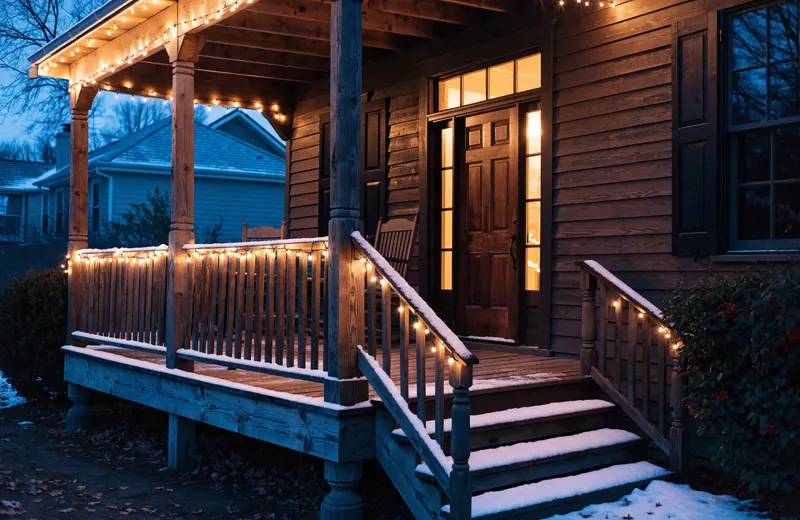
December's list is mostly about the things you plug in and light up, plus the year's first serious cold. It ends with ten minutes of record-keeping: the ages of the alarms and the water heater decide next year's list.
Decorate by the fire officials' rules
USFA: inspect holiday lights every year before you put them up; throw away strands with frayed or pinched wires; read the manufacturer's limit on how many strands to connect; keep candles at least 12 inches from anything that burns. CPSC: never string together more than three sets of incandescent lights, never overload outlets, and watch the ladder: about 160 decorating injuries a day happen in the season, nearly half from falls. Set it on stable ground, keep it away from the power lines, have someone hold it, and never stand on the top rung. ESFI: outdoor lights and decorations go on circuits protected by GFCIs, only cords and decorations marked for outdoor use go outside, and everything gets turned off before you leave or sleep.
If the tree is real, water it every day
USFA: water a real tree every day, because a dry tree burns very hot and very fast; keep it at least 3 feet from heat sources; and get rid of it after Christmas or as soon as it is dry.
The cold-snap routine, for the first real freeze
Open the cabinet doors under sinks on exterior walls, drip the faucets served by exposed pipes, keep the garage closed, hold the thermostat steady, and never thaw a pipe with a flame. The full Red Cross routine is in January. Keep a towel and the number of a licensed plumber where you can find them.
Winter storm outages: the generator rules do not change
CPSC's winter release repeats the summer rule: generators run outdoors only, at least 20 feet from the house, exhaust pointed away from windows, doors and vents, never in a garage even with the door open. Two more CPSC rules: never plug the generator into a wall outlet to feed the house wiring (backfeeding can electrocute utility workers and neighbors; the safe connection is a transfer switch installed by a licensed electrician), and turn it off and let it cool before refueling, because gasoline spilled on a hot engine can ignite. Never store the fuel in the house. Test the CO alarms the same day you fuel the generator.
Year-end: write down what is aging
Three dates decide next year's list. Smoke alarms: replace the whole unit at 10 years (USFA). CO alarms: per the manufacturer, or every 5 years by the CDC's default. The water heater: DOE says 10 to 15 years is typical, and IBHS says three quarters of all water heaters fail before year 12, with leak risk rising sharply from year 5. Write the install year of each on a strip of tape on the unit, and put the replacement year in the calendar.
Every month, all year
- Look at the furnace or air handler filter. Inspect, clean or change it once a month; during cooling season DOE says every month or two. How a filter works.
- Press the test button on every smoke alarm and carbon monoxide alarm. Both get a monthly test.
- Press TEST, then RESET, on each GFCI outlet, and the TEST button on any AFCI breakers in the panel. Monthly for both. If one will not reset or trip, that is an electrician call.
- Run water into any sink, tub or floor drain that does not get used. A trap only blocks sewer gas while it holds water, and once a month is the usual rule.
Previous: NovemberNext: January
The Monthly Almanac, by email
One email at the start of each month with that month's checklist for your region, and nothing else. Next month's list, in your inbox before the month starts.
Unsubscribe in any email. We never sell or share the list. Privacy.
References
- Holiday Fire Safety. U.S. Fire Administration (FEMA). https://www.usfa.fema.gov/prevention/home-fires/prevent-fires/holiday/
- Happy Holidays Start with Safety. U.S. Consumer Product Safety Commission. https://www.cpsc.gov/Newsroom/News-Releases/2025/Happy-Holidays-Start-with-Safety-CPSC-Urges-Families-to-Cook-Decorate-and-Select-Toys-with-Care-This-Season
- Outdoor Decoration Safety Tips. Electrical Safety Foundation International. https://www.esfi.org/outdoor-decoration-safety-tips/
- Home Safe: Outdoor Repairs checklist. U.S. Consumer Product Safety Commission. https://www.cpsc.gov/s3fs-public/Home_Safe_Outdoor-Repairs_checklist_COVID19_FINAL_0.pdf
- Preventing and Thawing Frozen Pipes. American Red Cross. https://www.redcross.org/get-help/how-to-prepare-for-emergencies/types-of-emergencies/winter-storm/frozen-pipes.html
- CPSC Issues Winter Weather Safety Tips to Prevent Fires and Carbon Monoxide Poisoning. U.S. Consumer Product Safety Commission. https://www.cpsc.gov/Newsroom/News-Releases/2026/CPSC-Issues-Winter-Weather-Safety-Tips-to-Prevent-Fires-and-Carbon-Monoxide-Poisoning
- CPSC Warns of Generator, Carbon Monoxide and Fire Hazards Ahead of Hurricane Season (May 27, 2026). U.S. Consumer Product Safety Commission. https://www.cpsc.gov/Newsroom/News-Releases/2026/CPSC-Warns-of-Generator-Carbon-Monoxide-and-Fire-Hazards-Ahead-of-Hurricane-Season
- Portable Generator Hazards (Safety Alert 5123). U.S. Consumer Product Safety Commission. https://www.cpsc.gov/s3fs-public/5123_SafetyAlert_PortableGenerators_102021_0.pdf
- Smoke Alarms. U.S. Fire Administration (FEMA). https://www.usfa.fema.gov/prevention/home-fires/prepare-for-fire/smoke-alarms/
- Carbon Monoxide Poisoning Basics. Centers for Disease Control and Prevention. https://www.cdc.gov/carbon-monoxide/about/index.html
- Which Water Heater Is Right for You?. U.S. Department of Energy, Energy Saver. https://www.energy.gov/energysaver/articles/which-water-heater-right-you
- Quick Tips to Prevent Water Damage (pamphlet). Insurance Institute for Business and Home Safety, hosted by the Connecticut Insurance Department. https://portal.ct.gov/-/media/CID/waterdamagepamphletCTDOIpdf.pdf
- Maintenance Checklist. ENERGY STAR. https://www.energystar.gov/saveathome/heating-cooling/maintenance-checklist
- Maintaining Your Air Conditioner. U.S. Department of Energy, Energy Saver. https://www.energy.gov/energysaver/maintaining-your-air-conditioner
- Ground Fault Circuit Interrupters (GFCI). Electrical Safety Foundation International. https://www.esfi.org/ground-fault-circuit-interrupters-gfci/
- How to Test an AFCI. Electrical Safety Foundation International. https://www.esfi.org/how-to-test-an-afci/
- Funky Smell? It Might Be a Dry Drain. Princeton University Office of Environmental Health and Safety. https://ehs.princeton.edu/news/keep-drain-traps-drying-out
Every fact and number on this page comes from one of the sources above, read during the writing of this page. Codes and standards vary by jurisdiction and edition; your local code and your equipment's manual control.