Summer, month 7 of 12
July
Peak heat. Give the outdoor unit room to breathe and keep the fans doing their job.
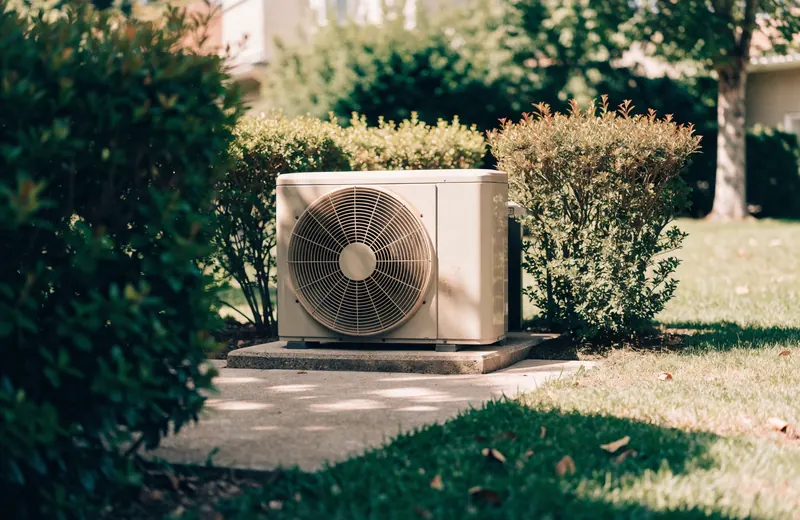
July is the hardest month on the cooling equipment and the easiest month to neglect everything else. Keep the list short: airflow at the outdoor unit, fan direction, outdoor outlets and a look at the fire extinguisher.
Give the outdoor unit two feet of clear air
DOE: clean the area around the outdoor coil, remove debris, and trim foliage back at least 2 feet for adequate airflow around the condenser. For heat pumps, with the power to the fan turned off, remove vegetation, dust, pollen and clutter from around the outdoor unit. Grass clippings from the mower are the usual July offender. Read how the refrigerant loop works to see why the outdoor coil needs air.
Use fans to raise the thermostat
DOE's number: a ceiling fan turning counterclockwise lets you raise the air conditioner's thermostat setting about 4 F with no reduction in comfort. The fan cools the person, not the room, so turn it off when you leave.
Test the outdoor and garage GFCIs before the pool pump and the power tools
Outdoor outlets have required GFCI protection since 1973, bathrooms since 1975, garages since 1978, kitchens since 1987, and crawl spaces and unfinished basements since 1990, so an older house may have gaps. CPSC's test: plug in a lamp, turn it on, press TEST; if the lamp does not go out, the GFCI is not working or was installed wrong. A GFCI cuts power when the current going out and coming back differ by as little as 0.006 amperes, which is what makes it the right device for wet locations.
Look at the fire extinguisher
The U.S. Fire Administration says most homes should have a multipurpose A-B-C extinguisher, the largest one a user can safely and comfortably operate, and that you should regularly check the pressure gauge and look for damage to the can, hose and nozzle, recharging or replacing as the maker directs. Remember PASS: Pull, Aim, Squeeze, Sweep. Fight only a small, contained fire with a clear exit behind you, after everyone is out and 911 has been called.
Every month, all year
- Look at the furnace or air handler filter. Inspect, clean or change it once a month; during cooling season DOE says every month or two. How a filter works.
- Press the test button on every smoke alarm and carbon monoxide alarm. Both get a monthly test.
- Press TEST, then RESET, on each GFCI outlet, and the TEST button on any AFCI breakers in the panel. Monthly for both. If one will not reset or trip, that is an electrician call.
- Run water into any sink, tub or floor drain that does not get used. A trap only blocks sewer gas while it holds water, and once a month is the usual rule.
The Monthly Almanac, by email
One email at the start of each month with that month's checklist for your region, and nothing else. Next month's list, in your inbox before the month starts.
Unsubscribe in any email. We never sell or share the list. Privacy.
References
- Maintaining Your Air Conditioner. U.S. Department of Energy, Energy Saver. https://www.energy.gov/energysaver/maintaining-your-air-conditioner
- Operating and Maintaining Your Heat Pump. U.S. Department of Energy, Energy Saver. https://www.energy.gov/energysaver/operating-and-maintaining-your-heat-pump
- How to Clean an AC Unit. Bryant. https://www.bryant.com/en/us/products/air-conditioners/how-to-clean/
- Fans for Cooling. U.S. Department of Energy, Energy Saver. https://www.energy.gov/energysaver/fans-cooling
- GFCIs Fact Sheet (Document 099). U.S. Consumer Product Safety Commission. https://www.cpsc.gov/s3fs-public/099_0.pdf
- Choosing and Using Fire Extinguishers. U.S. Fire Administration (FEMA). https://www.usfa.fema.gov/prevention/home-fires/prepare-for-fire/fire-extinguishers/
- Maintenance Checklist. ENERGY STAR. https://www.energystar.gov/saveathome/heating-cooling/maintenance-checklist
- Smoke Alarms. U.S. Fire Administration (FEMA). https://www.usfa.fema.gov/prevention/home-fires/prepare-for-fire/smoke-alarms/
- CPSC Warns of Generator, Carbon Monoxide and Fire Hazards Ahead of Hurricane Season (May 27, 2026). U.S. Consumer Product Safety Commission. https://www.cpsc.gov/Newsroom/News-Releases/2026/CPSC-Warns-of-Generator-Carbon-Monoxide-and-Fire-Hazards-Ahead-of-Hurricane-Season
- Ground Fault Circuit Interrupters (GFCI). Electrical Safety Foundation International. https://www.esfi.org/ground-fault-circuit-interrupters-gfci/
- How to Test an AFCI. Electrical Safety Foundation International. https://www.esfi.org/how-to-test-an-afci/
- Funky Smell? It Might Be a Dry Drain. Princeton University Office of Environmental Health and Safety. https://ehs.princeton.edu/news/keep-drain-traps-drying-out
Every fact and number on this page comes from one of the sources above, read during the writing of this page. Codes and standards vary by jurisdiction and edition; your local code and your equipment's manual control.