Fall, month 11 of 12
November
Heating season begins. Clocks fall back, fans reverse, and the thermostat routine starts.
Daylight saving time ends the first Sunday of November
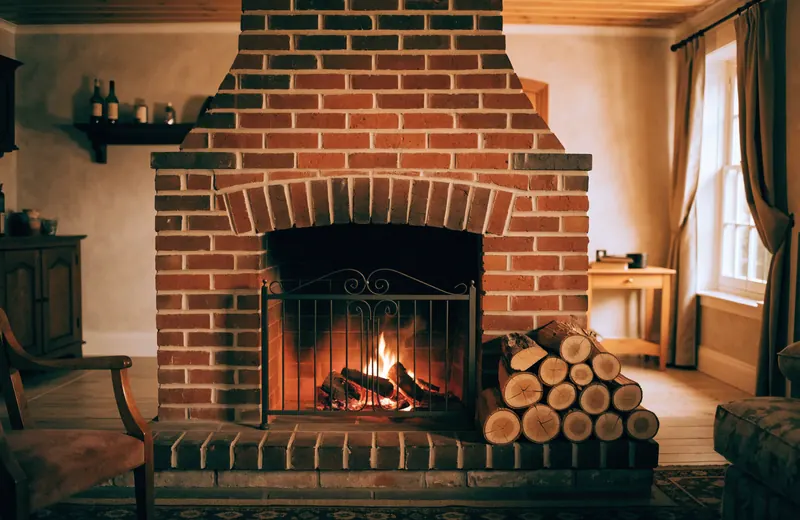
November is the first month of real heating in most of the country. The clocks change on the first Sunday, with the battery reminder that comes with it; ceiling fans reverse; and the pipe-protection routine from the Red Cross becomes the standing order for the winter.
Clocks fall back: batteries, and the ten-year check
Daylight saving time ends at 2 a.m. on the first Sunday of November. Use it the way the CDC and CPSC suggest: check or change the batteries in the smoke and CO alarms. Then look at the date stamped on the back of each smoke alarm; USFA says to replace the whole unit every 10 years, and CO alarms per the manufacturer (the CDC's default is every 5 years).
Reverse the ceiling fans
DOE: in winter, reverse the ceiling fan to turn clockwise and set it on low. That pushes the warm air that pools at the ceiling back down into the room without a draft.
Fireplace season: the three-foot rule and the eighth-inch rule
USFA: keep anything that can burn at least 3 feet from fireplaces and wood stoves, and have the chimney inspected and cleaned yearly by a professional. The Chimney Safety Institute of America's threshold for sweeping a masonry fireplace is 1/8 inch of sooty buildup, sooner if there is any glazed creosote.
Set the winter thermostat routine
The Red Cross: keep the thermostat set to the same temperature day and night during cold weather (a lower bill is not worth a frozen pipe), and when you travel leave the heat on at no lower than 55 F. IBHS goes further for long absences: away more than a week with subfreezing weather ongoing or forecast, consider closing the main water valve slowly and draining a couple of lowest-floor faucets. Know where the main shutoff is before you need it; most are a gate valve or ball valve where the line enters the house.
If the outdoor water is still on, shut it down now
For the Mid-country, Pacific coast and high-desert regions this is the month: hoses off and drained, inside valves closed, outside faucets opened to drain. See the October task for the full Red Cross list.
Humidity for the woodwork as the heat comes on
Wood in service is always exchanging moisture with the air. The Forest Products Laboratory notes daily changes are small, but seasonal ones add up; as the furnace runs, floors and trim give up moisture and shrink. NWFA's year-round target of 30 to 50 percent relative humidity is the number to hold, with a humidifier if the house drops below it. The EPA's upper limit of 60 percent still applies at the other end.
Every month, all year
- Look at the furnace or air handler filter. Inspect, clean or change it once a month; during cooling season DOE says every month or two. How a filter works.
- Press the test button on every smoke alarm and carbon monoxide alarm. Both get a monthly test.
- Press TEST, then RESET, on each GFCI outlet, and the TEST button on any AFCI breakers in the panel. Monthly for both. If one will not reset or trip, that is an electrician call.
- Run water into any sink, tub or floor drain that does not get used. A trap only blocks sewer gas while it holds water, and once a month is the usual rule.
Previous: OctoberNext: December
The Monthly Almanac, by email
One email at the start of each month with that month's checklist for your region, and nothing else. Next month's list, in your inbox before the month starts.
Unsubscribe in any email. We never sell or share the list. Privacy.
References
- Daylight Saving Time Rules. National Institute of Standards and Technology. https://www.nist.gov/pml/time-and-frequency-division/popular-links/daylight-saving-time-dst
- Carbon Monoxide Poisoning Basics. Centers for Disease Control and Prevention. https://www.cdc.gov/carbon-monoxide/about/index.html
- Change your Clocks, Change your Batteries!. U.S. Consumer Product Safety Commission. https://www.cpsc.gov/Newsroom/News-Releases/2018/Change-your-Clocks-Change-your-Batteries
- Smoke Alarms. U.S. Fire Administration (FEMA). https://www.usfa.fema.gov/prevention/home-fires/prepare-for-fire/smoke-alarms/
- Fans for Cooling. U.S. Department of Energy, Energy Saver. https://www.energy.gov/energysaver/fans-cooling
- Heating Fire Safety. U.S. Fire Administration (FEMA). https://www.usfa.fema.gov/prevention/home-fires/prevent-fires/heating/
- Homeowner Resources. Chimney Safety Institute of America. https://www.csia.org/homeowner-resources
- Preventing and Thawing Frozen Pipes. American Red Cross. https://www.redcross.org/get-help/how-to-prepare-for-emergencies/types-of-emergencies/winter-storm/frozen-pipes.html
- IBHS Winter Weather Ready guide news release (Nov. 14, 2024). Insurance Institute for Business and Home Safety. https://ibhs.org/ibhs-news-releases/ibhs-winter-weather-ready-guide-provides-easy-to-do-actions-to-help-prevent-property-damage-from-colder-temperatures/
- How to Turn Off Your Water. Western Municipal Water District, California. https://westernwaterca.gov/392/How-to-Turn-Off-Your-Water
- Wood Handbook (FPL-GTR-282, 2021), Chapter 13: Drying and Control of Moisture Content and Dimensional Changes. USDA Forest Service, Forest Products Laboratory. https://www.fpl.fs.usda.gov/documnts/fplgtr/fplgtr282/chapter_13_fpl_gtr282.pdf
- Problem Prevention. National Wood Flooring Association. https://woodfloors.org/problem-prevention/
- A Brief Guide to Mold, Moisture and Your Home. U.S. Environmental Protection Agency. https://www.epa.gov/mold/brief-guide-mold-moisture-and-your-home
- Maintenance Checklist. ENERGY STAR. https://www.energystar.gov/saveathome/heating-cooling/maintenance-checklist
- Maintaining Your Air Conditioner. U.S. Department of Energy, Energy Saver. https://www.energy.gov/energysaver/maintaining-your-air-conditioner
- CPSC Warns of Generator, Carbon Monoxide and Fire Hazards Ahead of Hurricane Season (May 27, 2026). U.S. Consumer Product Safety Commission. https://www.cpsc.gov/Newsroom/News-Releases/2026/CPSC-Warns-of-Generator-Carbon-Monoxide-and-Fire-Hazards-Ahead-of-Hurricane-Season
- Ground Fault Circuit Interrupters (GFCI). Electrical Safety Foundation International. https://www.esfi.org/ground-fault-circuit-interrupters-gfci/
- How to Test an AFCI. Electrical Safety Foundation International. https://www.esfi.org/how-to-test-an-afci/
- Funky Smell? It Might Be a Dry Drain. Princeton University Office of Environmental Health and Safety. https://ehs.princeton.edu/news/keep-drain-traps-drying-out
Every fact and number on this page comes from one of the sources above, read during the writing of this page. Codes and standards vary by jurisdiction and edition; your local code and your equipment's manual control.