Winter, month 1 of 12
January
Deep winter. Keep water liquid, air safe and the roof edge clear.
National Radon Action Month (EPA)
January is the month the house is working hardest for you. The furnace runs most of the day, pipes in the cold corners of the house are at their most vulnerable, and windows stay shut, which is why the EPA puts radon testing here. Nothing on this list takes more than an evening.
Test the house for radon
The EPA marks January as National Radon Action Month and encourages every household to test. Radon is the number one cause of lung cancer among non-smokers by EPA's estimate, tied to about 21,000 lung cancer deaths a year. Do-it-yourself kits are sold online and at most hardware stores. EPA recommends fixing the house if the result is 4 pCi/L or higher, and considering a fix between 2 and 4 pCi/L.
Run the cold-snap routine when a hard freeze is forecast
When the forecast turns bitter, the American Red Cross routine is simple: open the kitchen and bathroom cabinet doors so warm air reaches the plumbing, let cold water drip from any faucet served by exposed pipes, keep the garage door closed if there are water lines in the garage, and leave the thermostat at the same setting day and night. If you travel, leave the heat on at no lower than 55 F. If a pipe does freeze, keep the faucet open and warm the pipe with a hair dryer, heating pad or hot towels, never a blowtorch, propane or kerosene heater, charcoal stove or any open flame. If you cannot find or reach the frozen section, call a licensed plumber.
Watch the roof edge for ice dams
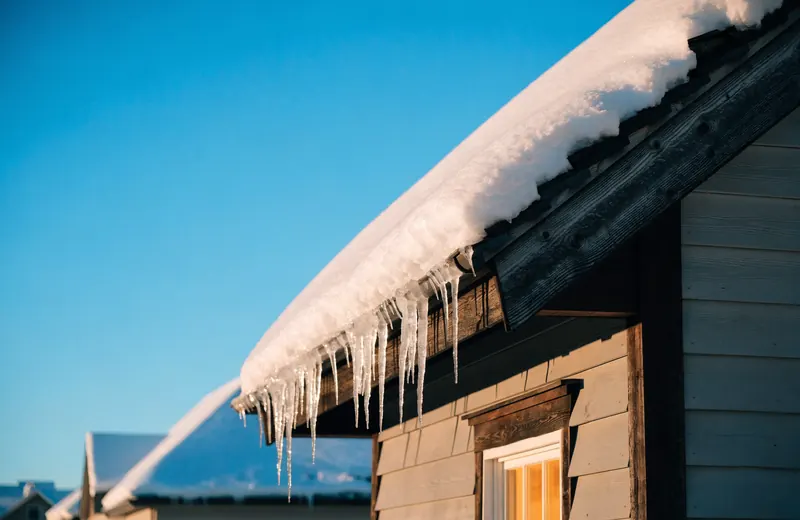
An ice dam is a ridge of ice at the edge of the roof that keeps melting snow from draining, so water backs up behind it and can leak into the house. It needs three things: snow on the roof, a roof surface above 32 F higher up, and an edge below 32 F. Minnesota's energy office calls attic air leaks (around plumbing vents, wiring and chimneys) the primary cause. The lasting fix, per the University of Minnesota, is to make the ceiling airtight so warm moist house air cannot reach the attic, then add insulation. A roof rake, used from the ground, can pull snow off the lower roof but can damage shingles, and a channel melted through the dam stops working within days. The University of Minnesota's warning goes with both: anyone on the roof in winter, or working on it from below, risks injury and roof damage, so ice removal is a job for professionals. Stay off the roof and off ladders on ice.
Use space heaters by the three-foot rule
The U.S. Fire Administration's rule is to keep anything that can burn at least 3 feet from all heat sources, including fireplaces, wood stoves, radiators, space heaters and candles, and to turn space heaters off when you leave the room or go to bed. CPSC adds: always plug an electric portable heater into a wall outlet, never a power strip, and keep all sides of it at least three feet from beds, clothes, curtains, papers and sofas. Heating fires are the second leading cause of home fires.
If the heating system was not serviced in the fall, book it now
The CDC's carbon monoxide guidance is to have the heating system, water heater and any other gas, oil or coal burning appliance serviced by a qualified technician every year. A leaking furnace heat exchanger can mix combustion gases, including carbon monoxide, into the house air, and CO is colorless and odorless. Read how a gas furnace cycles to see what the technician is checking.
Every month, all year
- Look at the furnace or air handler filter. Inspect, clean or change it once a month; during cooling season DOE says every month or two. How a filter works.
- Press the test button on every smoke alarm and carbon monoxide alarm. Both get a monthly test.
- Press TEST, then RESET, on each GFCI outlet, and the TEST button on any AFCI breakers in the panel. Monthly for both. If one will not reset or trip, that is an electrician call.
- Run water into any sink, tub or floor drain that does not get used. A trap only blocks sewer gas while it holds water, and once a month is the usual rule.
Previous: DecemberNext: February
The Monthly Almanac, by email
One email at the start of each month with that month's checklist for your region, and nothing else. Next month's list, in your inbox before the month starts.
Unsubscribe in any email. We never sell or share the list. Privacy.
References
- Prevent Lung Cancer by Testing Your Home for Radon (Jan. 2, 2025). U.S. Environmental Protection Agency. https://www.epa.gov/newsreleases/prevent-lung-cancer-testing-your-home-radon-0
- Health Risk of Radon. U.S. Environmental Protection Agency. https://www.epa.gov/radon/health-risk-radon
- What is EPA's Action Level for Radon and What Does it Mean?. U.S. Environmental Protection Agency. https://www.epa.gov/radon/what-epas-action-level-radon-and-what-does-it-mean
- Preventing and Thawing Frozen Pipes. American Red Cross. https://www.redcross.org/get-help/how-to-prepare-for-emergencies/types-of-emergencies/winter-storm/frozen-pipes.html
- Dealing with and preventing ice dams. University of Minnesota Extension. https://extension.umn.edu/protecting-home-rain-and-ice/dealing-and-preventing-ice-dams
- Home Energy Guide: Attic air leaks = ice dams. Minnesota Department of Commerce. https://mn.gov/commerce-stat/pdfs/ice-dams.pdf
- Heating Fire Safety. U.S. Fire Administration (FEMA). https://www.usfa.fema.gov/prevention/home-fires/prevent-fires/heating/
- CPSC Issues Winter Weather Safety Tips to Prevent Fires and Carbon Monoxide Poisoning. U.S. Consumer Product Safety Commission. https://www.cpsc.gov/Newsroom/News-Releases/2026/CPSC-Issues-Winter-Weather-Safety-Tips-to-Prevent-Fires-and-Carbon-Monoxide-Poisoning
- Carbon Monoxide Poisoning Basics. Centers for Disease Control and Prevention. https://www.cdc.gov/carbon-monoxide/about/index.html
- Furnaces and Boilers. U.S. Department of Energy, Energy Saver. https://www.energy.gov/node/374305
- Carbon Monoxide Questions and Answers. U.S. Consumer Product Safety Commission. https://www.cpsc.gov/Safety-Education/Safety-Education-Centers/Carbon-Monoxide-Information-Center/Carbon-Monoxide-Questions-and-Answers
- Maintenance Checklist. ENERGY STAR. https://www.energystar.gov/saveathome/heating-cooling/maintenance-checklist
- Maintaining Your Air Conditioner. U.S. Department of Energy, Energy Saver. https://www.energy.gov/energysaver/maintaining-your-air-conditioner
- Smoke Alarms. U.S. Fire Administration (FEMA). https://www.usfa.fema.gov/prevention/home-fires/prepare-for-fire/smoke-alarms/
- CPSC Warns of Generator, Carbon Monoxide and Fire Hazards Ahead of Hurricane Season (May 27, 2026). U.S. Consumer Product Safety Commission. https://www.cpsc.gov/Newsroom/News-Releases/2026/CPSC-Warns-of-Generator-Carbon-Monoxide-and-Fire-Hazards-Ahead-of-Hurricane-Season
- Ground Fault Circuit Interrupters (GFCI). Electrical Safety Foundation International. https://www.esfi.org/ground-fault-circuit-interrupters-gfci/
- How to Test an AFCI. Electrical Safety Foundation International. https://www.esfi.org/how-to-test-an-afci/
- Funky Smell? It Might Be a Dry Drain. Princeton University Office of Environmental Health and Safety. https://ehs.princeton.edu/news/keep-drain-traps-drying-out
Every fact and number on this page comes from one of the sources above, read during the writing of this page. Codes and standards vary by jurisdiction and edition; your local code and your equipment's manual control.