Winter, month 2 of 12
February
The quiet month. Give the water heater and the appliances the attention they never get.
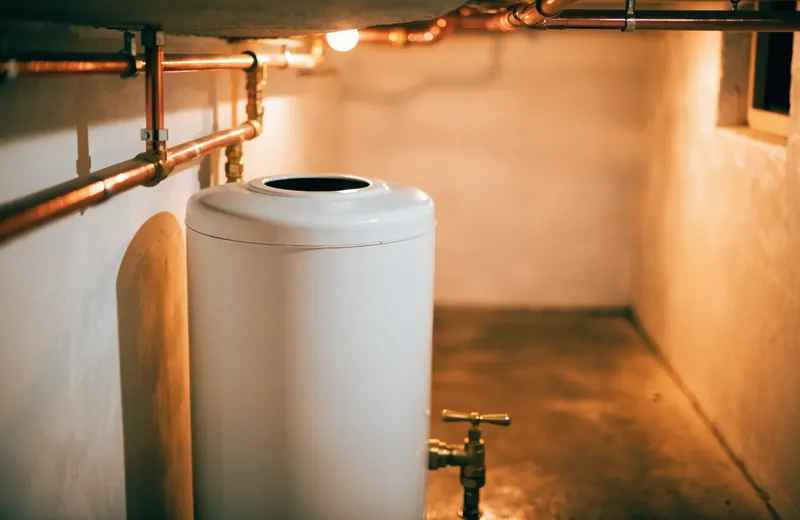
February is short and indoors, which makes it the right month for the jobs that happen in the basement and the laundry room: the water heater, the washing machine hoses, the dryer and the refrigerator coils. It is also the month dry winter air shows up in the woodwork.
Give the water heater its annual check
Start with the thermostat. On a gas heater the dial is on the gas control near the bottom of the tank. On an electric heater the thermostats sit behind access panels on the side of the tank, and DOE says to shut off the electricity to the heater at its breaker before removing or opening those panels. DOE says most households only need 120 F even though some heaters ship at 140 F, and the lower setting slows mineral buildup and corrosion; DOE puts the standby savings at $36 to $61 a year. CPSC urges 120 F for a second reason: 140 F water can burn in about six seconds. Next, sediment. University of Florida extension suggests draining about a quart from the tank every 3 to 6 months; A. O. Smith says most tanks need a flush at least once a year, so follow your heater's manual. Either way the water at the drain valve is as hot as the tank: A. O. Smith says to turn the heater off a few hours beforehand so it cools, wear thick gloves and safety goggles, and run the water into a bucket or through a hose to a floor drain. Then the temperature and pressure relief valve. First find its discharge pipe and make sure it runs down to within a few inches of the floor or a drain with nothing in the way; if there is no pipe, or it is capped, stop and call a plumber. Then lift the lever briefly a few times and confirm water comes out of the pipe, keeping hands and feet clear because it can be scalding. A valve that discharges nothing, or one that keeps dripping afterward, needs replacing, and that is a plumber's job, because a relief valve that cannot open risks over-pressurizing the tank. Finally, the anode rod: IBHS recommends a professional inspection at least every 2 years, yearly once the warranty is up. DOE says water heaters typically last 10 to 15 years; IBHS says the chance of a leak rises sharply from year 5. Know yours.
Inspect the washing machine hoses
IBHS says to inspect the water supply hoses every 6 months (so again in August), that manufacturers recommend replacing them every 5 years, and to consider braided stainless steel hoses. Two habits from the same guide: turn the supply valves off when the washer is not in use, and do not run it while nobody is home.
Clean the refrigerator condenser coils
An older DOE appliance guide says cleaning the condenser coils every six to twelve months can improve efficiency by as much as 30 percent, and ENERGY STAR's appliance brochure says to keep the coils clean if you have an older model. Unplug the refrigerator, pull it out, and vacuum the coils on the back or behind the front grille. Repeat in August.
Expect gaps in the wood floors, and do not fill them
Winter heating dries the air, wood gives up moisture, and floorboards shrink across their width. The USDA Forest Products Laboratory says cracks develop in wood flooring when the wood picked up moisture before or after installation and then shrinks when the building is heated; seasonal changes, gradual as they are, matter more than daily ones. The National Wood Flooring Association's prevention advice is to keep the house between 60 and 80 F and 30 to 50 percent relative humidity year-round. The gaps close again in summer, which is why filling them in winter is a mistake. Read how wood moves with the seasons.
Every month, all year
- Look at the furnace or air handler filter. Inspect, clean or change it once a month; during cooling season DOE says every month or two. How a filter works.
- Press the test button on every smoke alarm and carbon monoxide alarm. Both get a monthly test.
- Press TEST, then RESET, on each GFCI outlet, and the TEST button on any AFCI breakers in the panel. Monthly for both. If one will not reset or trip, that is an electrician call.
- Run water into any sink, tub or floor drain that does not get used. A trap only blocks sewer gas while it holds water, and once a month is the usual rule.
The Monthly Almanac, by email
One email at the start of each month with that month's checklist for your region, and nothing else. Next month's list, in your inbox before the month starts.
Unsubscribe in any email. We never sell or share the list. Privacy.
References
- Lowering your water heating temperature (Energy Saver). U.S. Department of Energy. https://www.energy.gov/node/611861
- Avoiding Tap Water Scalds (Document 5098). U.S. Consumer Product Safety Commission. https://www.cpsc.gov/s3fs-public/5098-Tap-Water-Scalds.pdf
- Energy Efficient Homes: Water Heaters (FCS3277). University of Florida IFAS Extension. https://ask.ifas.ufl.edu/publication/FY1025
- Water Heater Maintenance Guide. A. O. Smith. https://www.hotwater.com/info-center/water-heater-maintenance.html
- Quick Tips to Prevent Water Damage (pamphlet). Insurance Institute for Business and Home Safety, hosted by the Connecticut Insurance Department. https://portal.ct.gov/-/media/CID/waterdamagepamphletCTDOIpdf.pdf
- Which Water Heater Is Right for You?. U.S. Department of Energy, Energy Saver. https://www.energy.gov/energysaver/articles/which-water-heater-right-you
- Water Heater Safety in the International Codes (2019). International Code Council, Building Safety Journal. https://www.iccsafe.org/building-safety-journal/bsj-technical/water-heater-safety-in-the-international-codes/
- Energy-Efficient Appliances: Selection and Maintenance Guidelines for Major Home Appliances. U.S. Department of Energy. https://www1.eere.energy.gov/buildings/publications/pdfs/building_america/26468.pdf
- Wood Handbook (FPL-GTR-282, 2021), Chapter 13: Drying and Control of Moisture Content and Dimensional Changes. USDA Forest Service, Forest Products Laboratory. https://www.fpl.fs.usda.gov/documnts/fplgtr/fplgtr282/chapter_13_fpl_gtr282.pdf
- Problem Prevention. National Wood Flooring Association. https://woodfloors.org/problem-prevention/
- Maintenance Checklist. ENERGY STAR. https://www.energystar.gov/saveathome/heating-cooling/maintenance-checklist
- Maintaining Your Air Conditioner. U.S. Department of Energy, Energy Saver. https://www.energy.gov/energysaver/maintaining-your-air-conditioner
- Smoke Alarms. U.S. Fire Administration (FEMA). https://www.usfa.fema.gov/prevention/home-fires/prepare-for-fire/smoke-alarms/
- CPSC Warns of Generator, Carbon Monoxide and Fire Hazards Ahead of Hurricane Season (May 27, 2026). U.S. Consumer Product Safety Commission. https://www.cpsc.gov/Newsroom/News-Releases/2026/CPSC-Warns-of-Generator-Carbon-Monoxide-and-Fire-Hazards-Ahead-of-Hurricane-Season
- Ground Fault Circuit Interrupters (GFCI). Electrical Safety Foundation International. https://www.esfi.org/ground-fault-circuit-interrupters-gfci/
- How to Test an AFCI. Electrical Safety Foundation International. https://www.esfi.org/how-to-test-an-afci/
- Funky Smell? It Might Be a Dry Drain. Princeton University Office of Environmental Health and Safety. https://ehs.princeton.edu/news/keep-drain-traps-drying-out
Every fact and number on this page comes from one of the sources above, read during the writing of this page. Codes and standards vary by jurisdiction and edition; your local code and your equipment's manual control.