Summer, month 6 of 12
June
Cooling season in earnest. Filters, drains and the storm supplies.
Atlantic hurricane season begins June 1 (NOAA)
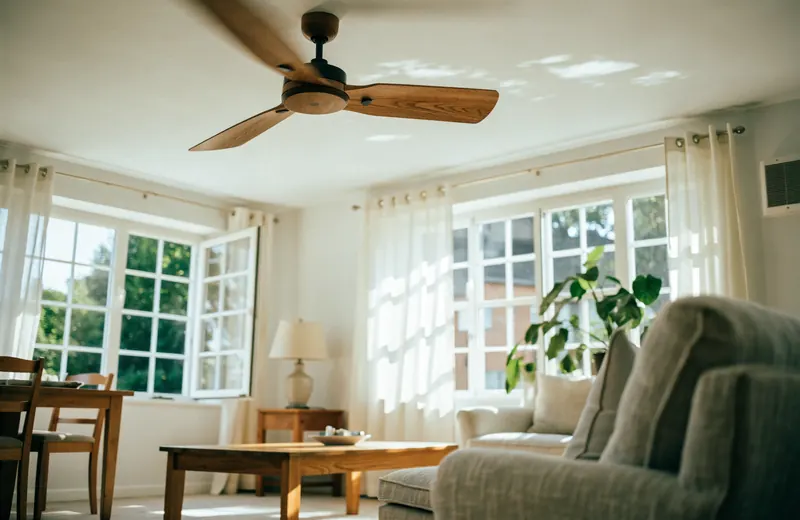
June is when the air conditioner stops being optional. The filter schedule tightens, the condensate drain becomes the part most likely to cause a surprise, and hurricane season opens on the first of the month.
Tighten the filter schedule for cooling season
DOE says to clean or replace the air conditioner's filter every month or two during the cooling season, and that replacing a dirty, clogged filter can lower energy use by 5 to 15 percent. ENERGY STAR's standing rule is to inspect it once a month. A filter can only clean air while the fan is running, and most systems run less than a quarter of the time, so the filter's main job is protecting the coil and blower. Read how a furnace and AC filter works.
Keep the condensate drain clear
Cooling pulls moisture out of the air at the indoor coil; it drips into a pan and out through a condensate line. Drains clog with dirt, mold and debris, and on modern systems an overflow switch then shuts down the compressor, the outdoor fan and the supply fan to prevent water damage, which is why a sudden cooling shutdown on a hot day often points to the drain. The EPA's mold guide says to keep the drip pan clean and the drain line unobstructed. DOE's homeowner fix is a stiff wire through the drain channels.
Hurricane season opens: stock the supplies
NOAA: a minimum of 3 days of food, water and medicine, and a storm plan written before the first watch. CPSC's generator rules, written for this season: never run a portable generator inside a home, garage, basement, crawl space or shed, even with doors open; run it outdoors at least 20 feet from the house with the exhaust pointed away from windows, doors and vents; and have working CO alarms with battery backup on every level and outside sleeping areas. Two CPSC rules that do not change with the season: never plug a generator into a wall outlet to power the house, and turn it off and let it cool before refueling.
Keep indoor humidity under 60 percent
The EPA's target is indoor relative humidity below 60 percent, ideally 30 to 50. A working air conditioner is the main dehumidifier in most houses; if it cools the house but the air stays clammy, the system may be oversized or the coil may need a look from a technician. Run the bath fan when showering and vent the dryer outside.
Expect drawers and doors to tighten up
Purdue's extension guide puts it plainly: when the air is humid, wood adsorbs moisture and swells; when the air is dry it shrinks, and drawers that moved easily in the factory can stick tightly in service. Paint, varnish and lacquer slow the moisture change but do not prevent it. Wax on drawer runners gets most through the summer; plane only what still binds in the dry season, or you will have a loose drawer in January.
Every month, all year
- Look at the furnace or air handler filter. Inspect, clean or change it once a month; during cooling season DOE says every month or two. How a filter works.
- Press the test button on every smoke alarm and carbon monoxide alarm. Both get a monthly test.
- Press TEST, then RESET, on each GFCI outlet, and the TEST button on any AFCI breakers in the panel. Monthly for both. If one will not reset or trip, that is an electrician call.
- Run water into any sink, tub or floor drain that does not get used. A trap only blocks sewer gas while it holds water, and once a month is the usual rule.
The Monthly Almanac, by email
One email at the start of each month with that month's checklist for your region, and nothing else. Next month's list, in your inbox before the month starts.
Unsubscribe in any email. We never sell or share the list. Privacy.
References
- Maintaining Your Air Conditioner. U.S. Department of Energy, Energy Saver. https://www.energy.gov/energysaver/maintaining-your-air-conditioner
- Maintenance Checklist. ENERGY STAR. https://www.energystar.gov/saveathome/heating-cooling/maintenance-checklist
- Guide to Air Cleaners in the Home. U.S. Environmental Protection Agency. https://www.epa.gov/indoor-air-quality-iaq/guide-air-cleaners-home
- Troubleshooting the HVAC Air Handler Overflow Switch. Trane. https://www.trane.com/residential/en/resources/troubleshooting/air-handlers/hvac-air-handler-overflow-switch/
- A Brief Guide to Mold, Moisture and Your Home. U.S. Environmental Protection Agency. https://www.epa.gov/mold/brief-guide-mold-moisture-and-your-home
- Prepare Before Hurricane Season. NOAA. https://www.noaa.gov/prepare-before-hurricane-season
- CPSC Warns of Generator, Carbon Monoxide and Fire Hazards Ahead of Hurricane Season (May 27, 2026). U.S. Consumer Product Safety Commission. https://www.cpsc.gov/Newsroom/News-Releases/2026/CPSC-Warns-of-Generator-Carbon-Monoxide-and-Fire-Hazards-Ahead-of-Hurricane-Season
- Carbon Monoxide Information Center. U.S. Consumer Product Safety Commission. https://www.cpsc.gov/Safety-Education/Safety-Education-Centers/Carbon-Monoxide-Information-Center
- Portable Generator Hazards (Safety Alert 5123). U.S. Consumer Product Safety Commission. https://www.cpsc.gov/s3fs-public/5123_SafetyAlert_PortableGenerators_102021_0.pdf
- The Shrinking and Swelling of Wood and Its Effect on Furniture (FNR-163). Purdue University Forestry and Natural Resources. https://www.extension.purdue.edu/extmedia/FNR/FNR-163.pdf
- Wood Handbook (FPL-GTR-282, 2021), Chapter 4: Moisture Relations and Physical Properties of Wood. USDA Forest Service, Forest Products Laboratory. https://www.fpl.fs.usda.gov/documnts/fplgtr/fplgtr282/chapter_04_fpl_gtr282.pdf
- Smoke Alarms. U.S. Fire Administration (FEMA). https://www.usfa.fema.gov/prevention/home-fires/prepare-for-fire/smoke-alarms/
- Ground Fault Circuit Interrupters (GFCI). Electrical Safety Foundation International. https://www.esfi.org/ground-fault-circuit-interrupters-gfci/
- How to Test an AFCI. Electrical Safety Foundation International. https://www.esfi.org/how-to-test-an-afci/
- Funky Smell? It Might Be a Dry Drain. Princeton University Office of Environmental Health and Safety. https://ehs.princeton.edu/news/keep-drain-traps-drying-out
Every fact and number on this page comes from one of the sources above, read during the writing of this page. Codes and standards vary by jurisdiction and edition; your local code and your equipment's manual control.