Summer, month 8 of 12
August
Peak hurricane season approaches, and the six-month appliance checks come around again.
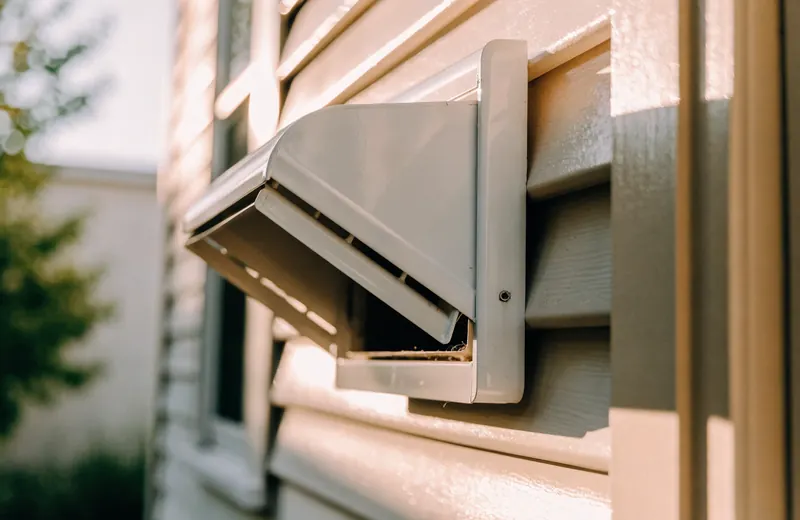
August brings the second round of the February laundry-room checks, the annual dryer vent cleaning, and the moment to book the furnace tune-up before the fall rush. Along the coasts, it is the month to re-read the storm plan: Atlantic activity peaks from August through October.
Clean the dryer vent, all the way outside
NFPA: the leading cause of home dryer and washer fires is failure to clean them. Clean the lint filter before or after every load and never run the dryer without it. Once a year, or more often if clothes are taking longer to dry, clean the lint out of the vent pipe, and use rigid or flexible metal venting, not plastic or foil. USFA adds: make sure the outdoor vent flap actually opens while the dryer runs. Go outside, run the dryer, and watch the flap.
Inspect the washing machine hoses again
The second of IBHS's twice-a-year hose inspections (the first was in February). Look for bulges, cracks and corrosion at the fittings; replace at 5 years regardless, and consider braided stainless steel.
Clean the refrigerator coils again
The second cleaning on the six-to-twelve-month schedule from DOE's appliance guide. Unplug, pull out, vacuum.
Book the heating system's fall check-up now
ENERGY STAR: check the heating system in the fall, before contractors get busy. A heating tune-up checks all gas or oil connections, gas pressure, burner combustion and the heat exchanger, along with the thermostat, electrical connections, lubrication, condensate drain and controls. A dirty burner or cracked heat exchanger makes the equipment operate less safely and less efficiently. Call in August and you get to pick the date.
Re-read the storm plan: the Atlantic peak is coming
NOAA: Atlantic hurricane activity peaks from August through October, with the maximum in early to mid September. Check the shutters, the panels and the supplies you stocked in May and June; top up the 3 days of water, food and medicine.
Every month, all year
- Look at the furnace or air handler filter. Inspect, clean or change it once a month; during cooling season DOE says every month or two. How a filter works.
- Press the test button on every smoke alarm and carbon monoxide alarm. Both get a monthly test.
- Press TEST, then RESET, on each GFCI outlet, and the TEST button on any AFCI breakers in the panel. Monthly for both. If one will not reset or trip, that is an electrician call.
- Run water into any sink, tub or floor drain that does not get used. A trap only blocks sewer gas while it holds water, and once a month is the usual rule.
The Monthly Almanac, by email
One email at the start of each month with that month's checklist for your region, and nothing else. Next month's list, in your inbox before the month starts.
Unsubscribe in any email. We never sell or share the list. Privacy.
References
- Clothes Dryer and Washing Machine Safety (tip sheet). NFPA Public Education Division, hosted by the U.S. Department of Energy. https://www.energy.gov/sites/prod/files/2016/06/f32/NFPA_DryerWasherSafetyTips.pdf
- Clothes Dryer Fire Safety (flyer). U.S. Fire Administration (FEMA). https://www.usfa.fema.gov/downloads/pdf/publications/clothes_dryer_fire_safety_flyer.pdf
- Quick Tips to Prevent Water Damage (pamphlet). Insurance Institute for Business and Home Safety, hosted by the Connecticut Insurance Department. https://portal.ct.gov/-/media/CID/waterdamagepamphletCTDOIpdf.pdf
- Energy-Efficient Appliances: Selection and Maintenance Guidelines for Major Home Appliances. U.S. Department of Energy. https://www1.eere.energy.gov/buildings/publications/pdfs/building_america/26468.pdf
- Maintenance Checklist. ENERGY STAR. https://www.energystar.gov/saveathome/heating-cooling/maintenance-checklist
- Hurricane FAQ. NOAA Atlantic Oceanographic and Meteorological Laboratory. https://www.aoml.noaa.gov/hrd-faq/
- Prepare Before Hurricane Season. NOAA. https://www.noaa.gov/prepare-before-hurricane-season
- Maintaining Your Air Conditioner. U.S. Department of Energy, Energy Saver. https://www.energy.gov/energysaver/maintaining-your-air-conditioner
- Smoke Alarms. U.S. Fire Administration (FEMA). https://www.usfa.fema.gov/prevention/home-fires/prepare-for-fire/smoke-alarms/
- CPSC Warns of Generator, Carbon Monoxide and Fire Hazards Ahead of Hurricane Season (May 27, 2026). U.S. Consumer Product Safety Commission. https://www.cpsc.gov/Newsroom/News-Releases/2026/CPSC-Warns-of-Generator-Carbon-Monoxide-and-Fire-Hazards-Ahead-of-Hurricane-Season
- Ground Fault Circuit Interrupters (GFCI). Electrical Safety Foundation International. https://www.esfi.org/ground-fault-circuit-interrupters-gfci/
- How to Test an AFCI. Electrical Safety Foundation International. https://www.esfi.org/how-to-test-an-afci/
- Funky Smell? It Might Be a Dry Drain. Princeton University Office of Environmental Health and Safety. https://ehs.princeton.edu/news/keep-drain-traps-drying-out
Every fact and number on this page comes from one of the sources above, read during the writing of this page. Codes and standards vary by jurisdiction and edition; your local code and your equipment's manual control.