How it works: HVAC
How a central air conditioner and a heat pump move heat
Nothing is made cold. Heat is moved from where you are to where you are not.
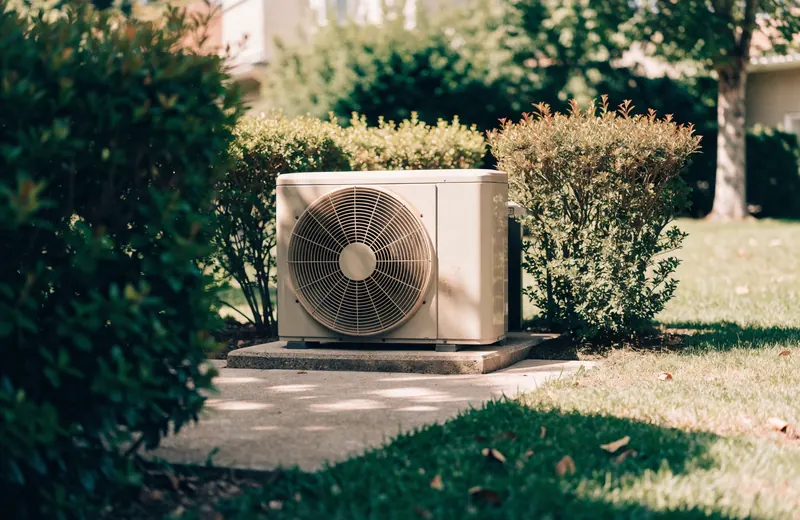
An air conditioner does not make cold. It collects heat from the air inside the house and carries it outside, using a fluid, the refrigerant, that boils at a low temperature. The equipment is a loop with four stations, and a heat pump is the same loop with a valve that lets it run in either direction.
The loop
1. The indoor coil absorbs heat. Liquid refrigerant at low pressure enters the evaporator coil inside the air handler or on top of the furnace. House air blown across the coil is warmer than the refrigerant, so the refrigerant boils, and in evaporating it pulls heat out of the indoor air and cools your home. The air leaving the coil is cooler and drier.
2. The compressor raises pressure and temperature. The vapor travels to the outdoor unit, where the compressor, a pump, squeezes it into a high-pressure, high-temperature gas. DOE’s description is the simplest: the compressor moves a heat transfer fluid between the evaporator and the condenser.
3. The outdoor coil releases heat. The hot gas flows through the condenser coil, the finned coil wrapped around the outdoor unit. The outdoor air blown through it is cooler than the gas, so the gas gives up its heat and condenses back into a warm liquid. That is the heat from your living room leaving the building.
4. The expansion device drops the pressure. The warm liquid passes through a metering device on its way back indoors. As its pressure drops it expands and gets cold, and the loop starts again at the indoor coil. Better systems use a thermostatic expansion valve for more precise control of the refrigerant flow to the indoor coil.
The heat pump’s trick
A heat pump transfers heat rather than converting it from a fuel like a combustion heating system does. In summer it is an air conditioner. In winter a reversing valve near the compressor changes the direction of refrigerant flow, so the outdoor coil becomes the evaporator and collects heat from the outside air (there is heat in cold air; the refrigerant is colder still) and the indoor coil becomes the condenser and releases it into the house. The same valve is used to defrost the outdoor coil in winter, which is why a heat pump sometimes steams and sounds different for a few minutes on a cold morning.
Reading the efficiency labels
Since January 1, 2023, DOE has tested systems under a new procedure, so the ratings are SEER2, EER2 and HSPF2, and they are not directly comparable to the older SEER and HSPF numbers.
- SEER2 is cooling efficiency: the total heat removed from the house during the cooling season, in Btu, divided by the electricity consumed.
- HSPF2 is a heat pump’s heating efficiency: the heat delivered over the heating season, in Btu, divided by the electricity consumed.
Federal minimums for split systems under the 2023 rules: central air conditioners at least 13.4 SEER2 nationally (14.3 SEER2 for most units installed in the Southeast and Southwest), and heat pumps at least 14.3 SEER2 and 7.5 HSPF2. ENERGY STAR’s bar for a split heat pump is at least 7.8 HSPF2, 15.2 SEER2 and 11.0 EER2. Capacity is rated in Btu per hour or in tons, one ton being 12,000 Btu per hour.
The condensate drain
Cooling pulls moisture out of the air as it crosses the cold indoor coil. The water drips into a pan and leaves through the condensate drain line. Drains clog with dirt, mold and debris, and modern air handlers carry an overflow (float) switch that, if it detects a potential overflow, shuts down the outdoor compressor and fan and the supply fan to prevent water damage. So a system that simply stops on a hot afternoon, with no breaker tripped, is often telling you the drain is blocked. DOE’s homeowner fix is to occasionally pass a stiff wire through the drain channels; clogged drain channels prevent a unit from reducing humidity.
What you can do
The homeowner side of this equipment is airflow and cleanliness:
- Clean the area around the outdoor coil, remove debris, and trim foliage back at least 2 feet so the condenser can breathe.
- Keep the filter clean (every month or two during cooling season), and have the indoor coil checked yearly and cleaned as necessary; if you open the cabinet to look, cut the power at the furnace switch or breaker first, and leave the cleaning to the tune-up.
- For a heat pump: clean or change filters every 3 months or as the manufacturer says, clean the outdoor coils when they are dirty, and with the fan power turned off remove vegetation, dust, pollen and clutter from around the outdoor unit. DOE says a well-maintained heat pump can use 10 to 25 percent less energy than a neglected one.
What is a technician’s job, and why
Refrigerant is not a homeowner material. Too much or too little makes the system less efficient, raises energy costs and shortens equipment life, so checking the charge and cleaning the coils are part of a professional tune-up, and refrigeration systems should be leak-checked at installation and at each service call. More than that: federal rules require technicians who maintain, service, repair or dispose of equipment that could release refrigerant to be EPA Section 608 certified, and it is illegal to intentionally vent refrigerant while servicing or disposing of air conditioning equipment.
One more part to leave alone: the capacitor. It gives the compressor and fan motors their starting kick, and a humming outdoor unit that will not start usually means a motor trying to start without the torque a failing capacitor should supply. Capacitors store charge even after the power is off, which is why Carrier says the repair should be handled by a qualified HVAC professional.
Related
References
- Air Conditioning. U.S. Department of Energy, Energy Saver. https://www.energy.gov/energysaver/home-cooling-systems/air-conditioning
- HVAC Compressors (glossary). Lennox. https://www.lennox.com/residential/buyers-guide/guide-to-hvac/glossary/compressor
- Condenser (glossary). Lennox. https://www.lennox.com/residential/buyers-guide/guide-to-hvac/glossary/condenser-coil
- Air-Source Heat Pumps. U.S. Department of Energy, Energy Saver. https://www.energy.gov/energysaver/heat-and-cool/heat-pump-systems/air-source-heat-pumps
- Heat Pump Equipment Key Product Criteria. ENERGY STAR. https://www.energystar.gov/products/air_source_heat_pumps/key-product-criteria
- Purchasing Energy-Efficient Residential Air-Source Heat Pumps. U.S. Department of Energy, Federal Energy Management Program. https://www.energy.gov/cmei/femp/purchasing-energy-efficient-residential-air-source-heat-pumps
- 10 CFR 430.32 Energy and water conservation standards and their compliance dates. eCFR. https://www.ecfr.gov/current/title-10/chapter-II/subchapter-D/part-430/subpart-C/section-430.32
- Troubleshooting the HVAC Air Handler Overflow Switch. Trane. https://www.trane.com/residential/en/resources/troubleshooting/air-handlers/hvac-air-handler-overflow-switch/
- Maintenance Checklist. ENERGY STAR. https://www.energystar.gov/saveathome/heating-cooling/maintenance-checklist
- Section 608 Technician Certification Requirements. U.S. Environmental Protection Agency. https://www.epa.gov/section608/section-608-technician-certification-requirements
- Stationary Refrigeration: Prohibition on Venting Refrigerants. U.S. Environmental Protection Agency. https://www.epa.gov/section608/stationary-refrigeration-prohibition-venting-refrigerants
- What is an AC Capacitor?. Carrier. https://www.carrier.com/residential/en/us/products/air-conditioners/ac-capacitor/
- Maintaining Your Air Conditioner. U.S. Department of Energy, Energy Saver. https://www.energy.gov/energysaver/maintaining-your-air-conditioner
- Operating and Maintaining Your Heat Pump. U.S. Department of Energy, Energy Saver. https://www.energy.gov/energysaver/operating-and-maintaining-your-heat-pump
Every fact and number on this page comes from one of the sources above, read during the writing of this page. Codes and standards vary by jurisdiction and edition; your local code and your equipment's manual control.