How it works: HVAC
How a hot water baseboard and boiler loop works
Where the water goes, why it runs at about 12 psi and 180 F, and what the tank, the vents and the relief valve are each there to do
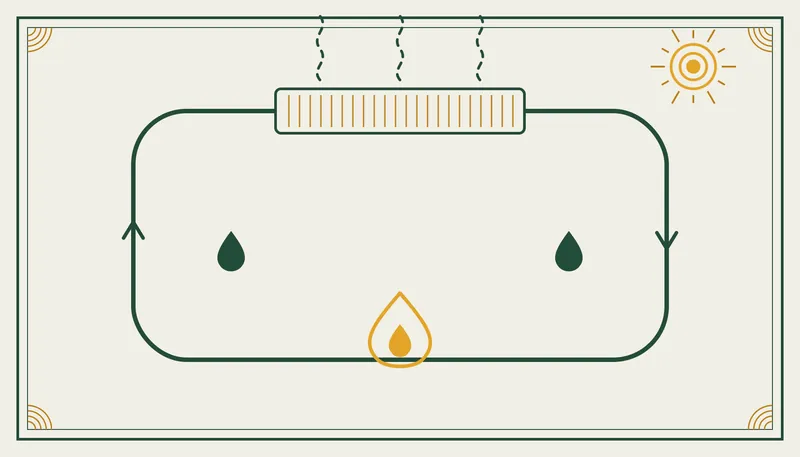
We keep a short rule for hot water heat: the water carries the heat, the pump carries the water, and the air gets shown the door. Keep all three straight and a hot water system will run quietly for decades, because almost everything bolted to the boiler is there to serve one of them.
The loop
A boiler heats water, and the U.S. Department of Energy’s Energy Saver guide says the hot water can be distributed through baseboard radiators or radiant floor systems. Caleffi’s Hydronic Fundamentals guide notes that the vast majority of modern hydronic heating systems are closed-loop systems: the same water goes around again and again, picking up heat at the boiler and leaving it in the rooms. The simplest layout is the series loop, which Caleffi describes as a single loop of piping that begins at the heat source, passes through several heat emitters, and ends back at the heat source.
The numbers that size the whole thing are temperatures. Caleffi says the traditional supply water for fin-tube baseboard is typically 180 to 200 F under design load, residential baseboard is traditionally sized on an average circuit temperature of 180 F, and series circuits are traditionally designed around a temperature drop of about 20 F. Caleffi’s rule ties flow to heat: Btu per hour equals 500 times the flow in gallons per minute times the temperature drop, where 500 is 8.33 (pounds in a gallon of water) times 60 (minutes in an hour). Worked through, 1 gallon a minute that loses 20 F delivers 500 x 1 x 20, or 10,000 Btu per hour, into the rooms.
What the baseboard does
The element inside a baseboard cover is a finned tube. Weil-McLain’s High Trim baseboard is 3/4 or 1 inch copper tube expanded into aluminum fins 2 1/8 by 2 3/4 inches, spaced 60 or 57.5 fins to the foot; Slant/Fin uses 3/4 or 1/2 inch copper with double bent aluminum fins. Room air in contact with the fins warms, rises out of the top of the enclosure, and pulls cooler air from the floor in underneath, which is why Slant/Fin’s ratings are for the element installed in its enclosure with the damper open. Slant/Fin calls it full room convection heating that blocks chilling drafts at the outside walls, and its damper, when closed, reduces convection air flow.
Output is rated per foot at an average water temperature, and it falls off fast as the water cools. Slant/Fin’s Fine/Line 30 table, at 1 gallon a minute and 65 F entering air:
- 200 F water: 710 Btu per hour per foot
- 190 F: 640
- 180 F: 580
- 170 F: 510
Slant/Fin’s Base/Line 2000 element gives 570 Btu per hour per foot at 180 F but only 360 at 150 F, about 37 percent less from 30 degrees cooler water. Two more details from the rating sheets catch people out. The ratings include a 15 percent heating effect factor under the I=B=R standard for baseboard radiation; John Siegenthaler explains that the credit is given because baseboard sits low on the wall where maximum heating effect results, and, where the baseboards are connected with PEX or insulated tubing that gives off far less heat than bare copper, advises dividing the ratings by 1.15 and sizing to the room’s design load. And Slant/Fin bases its ratings on active finned length, 5 to 6 inches less than the overall length, so output is figured from the fins, not from the length of the cover. The higher 4 gallon per minute ratings are only to be used, Slant/Fin says, when the flow is known to be at least that high.
The pressure in a closed loop
A hot water system runs under a modest pressure set by its fill valve. Watts says its 1156F feed water regulator is designed to fill the boiler and system piping with water and to maintain water pressure in the system at all times. Factory settings vary by maker: Watts sets its 911 and 1156F valves at 15 psi and Caleffi its AutoFill at 15 psi, while Bell and Gossett lists 12 psi as standard, adjustable from 10 to 25 psi on the Watts and Bell and Gossett valves and from 3 to 60 psi on the AutoFill.
The number is about height. R.L. Deppmann, a Bell and Gossett representative, gives the rule: take the elevation of the system above the gauge, divide by 2.31 (feet of water per psi), and add 4 psi for positive venting, so the vents at the top of the house still have pressure behind them and do not draw air in. Worked for a two-story house whose highest baseboard is 20 feet above the boiler gauge: 20 divided by 2.31 is about 8.7, plus 4 is about 12.7 psi.
The ceiling is the relief valve. Weil-McLain’s CGa boiler ships with a 30 psi ASME relief valve, and U.S. Boiler lists a maximum allowable working pressure of 30 psi for its Series 2 water boilers. Weil-McLain’s owner manual says the pressure on the boiler’s pressure and temperature gauge should not exceed 24 psig, 6 psi below the relief valve’s 30 psi setting.
The expansion tank
Bell and Gossett puts the reason plainly: when water is heated it expands, and provision must be made for this expansion in a closed hot water heating system. Amtrol’s table of net expansion gives a factor of 0.0351 from 40 F to 200 F, about 3.5 percent. A loop holding 30 gallons grows by about a gallon on the way from cold to hot, and in a sealed loop that gallon has to go somewhere.
A modern diaphragm tank holds a cushion of air behind a rubber diaphragm. Amtrol factory precharges its Extrol tanks to 12 psig and sizes them on a 12 psig fill and a 30 psig relief setting; the precharge, it says, is equal to the fill pressure, which keeps the diaphragm flush against the tank wall when the system is first filled. Its in-line instructions say to adjust the precharge to equal the system fill pressure. The mistake is leaving a tank at its factory 12 psi on a loop filled to 15.
Where the tank connects matters as much as its size. Caleffi calls that connection the point of no pressure change, because the pressure there stays the same whether the circulator is running or not, and says the most desirable results come when the pressure everywhere else in the system goes up as the circulator starts, which happens with the tank close to the inlet side of the circulator. Amtrol puts the tank on the suction side of the heating circulator, and Weil-McLain’s boiler manual asks for the same when possible. Pipe it the other way, with the tank on the circulator’s discharge, and Caleffi says the pressure in most of the loop drops when the circulator turns on; if it falls below atmospheric at a high point, air can be drawn in through float vents or loose valve packings.
Getting the air out
Fresh water carries dissolved air, and heating drives it out. Caleffi’s guide to air and dirt elimination gives the figures: at 30 psi absolute, water holds 3.6 percent dissolved gas by volume at 65 F but only 1.8 percent at 170 F, so heating 100 gallons from 65 F to 170 F releases about 1.8 gallons of air. Caleffi lists what air left in the loop does: noise in piping and emitters, reduced flow through circulators, poor heat transfer where emitter surfaces are not wetted, faster corrosion where oxygen meets iron and steel, and poor lubrication of circulator bushings.
The air is caught where it is easiest to catch. Caleffi says gas comes out of solution most readily where the water is hottest and the pressure lowest, which puts the separator near the outlet of the boiler; Weil-McLain says to install an air separator in the supply piping. Air also tends to come out high in a building, where the static pressure is lower, which is why high points get vents. An automatic float vent opens as air collects and lowers its float, then closes when water lifts it again, and it only works with its cap loosened; Weil-McLain says one turn. A manual bleed valve on an emitter is opened slightly and closed when water starts to escape.
Zones
A series loop is one zone on one thermostat, and the water cools as it goes, so the last baseboard on the loop sees the coolest water. Caleffi describes the ways around that. A diverter tee sends part of the flow through a branch to a short run of baseboard, and a single diverter tee is usually enough for a low-resistance emitter such as a few feet of fin-tube. One common way of zoning in North America, Caleffi says, is a separate circulator for each zone circuit.
The other common way is a zone valve per zone. Taco’s 571 heat motor zone valve shows the sequence: as the room cools to the thermostat setting, a contact in the thermostat closes and sends 24 volts to the valve’s heat motor; the heated wax element pushes the valve open; as the valve opens, its end switch closes, and the relay in the boiler or zone control box starts the circulator. When the thermostat is satisfied, a spring closes the valve. The valve has a manual opening lever.
Guards on the boiler
- High limit. Weil-McLain’s CGa manual gives a maximum operating limit of 210 F and allows an external high temperature limit up to 240 F, set at least 20 F above the operating setpoint. U.S. Boiler’s maximum allowable temperature is 250 F.
- Low water cutoff. Weil-McLain requires one when the boiler is installed above the radiation level, or where state, local or insurance rules call for it, and U.S. Boiler’s Series 2 manual says a low water cutoff device must be provided as part of the installation.
- Return water temperature. A conventional cast iron boiler wants its return water warm. Weil-McLain’s standard piping assumes return water of at least 130 F and outdoor reset systems must hold it no less than 130 F; Slant/Fin asks for a minimum 130 F return; Lochinvar’s protection guide uses 140 F for its non-condensing boilers. Below that, flue gas condenses inside the boiler, and Slant/Fin says the result is rust particles dropping from the cast iron sections and damaging the burners. A condensing boiler is built the other way round: Caleffi says condensation begins at an inlet water temperature of about 130 F, Deppmann puts it at about 125 to 130 F, and DOE puts high-efficiency systems, which condense flue gases in a second heat exchanger, at 90 to 98.5 percent AFUE. That is the trade at the heart of hydronic design: cooler water lets a condensing boiler pull more heat from the fuel, and the baseboard table above shows how much output each degree costs.
Homeowner or technician
The owner’s checks are short, and the gauge check is on the December page of the almanac with the other first-cold checks for furnaces and heat pumps. Weil-McLain’s user manual asks you to make sure the gauge does not read above 24 psig, to keep automatic vent caps loosened one turn, to look at the relief valve and its discharge pipe for weeping or leakage, and never to block the flow of combustion or ventilation air to the boiler. DOE’s older Energy Saver advice is to bleed the radiators at the start of each heating season while the system is running: open each bleed valve slightly and close it when water starts to escape, starting on the top floor. The water in a running system can be hot enough to scald, so hold a rag or cup under the valve and keep your hand clear. Leave the relief valve’s discharge pipe alone: Weil-McLain says it must pitch down from the valve and end at least 6 inches above the floor drain, must not run anywhere it could freeze, and must never have a shutoff valve in it or between the valve and the boiler. U.S. Boiler says it must be piped near the floor to eliminate the potential of severe burns.
The rest is technician work. Weil-McLain says to have the boiler started up and serviced at least annually by a qualified service technician, to have leaks fixed at once, and to contact the technician immediately if the relief valve often weeps. DOE lists testing the relief valve and high limit control and checking that the expansion tank holds air, not water, as maintenance for a heating system professional, and U.S. Boiler’s manual says service should be undertaken only by trained and skilled personnel. A gas or oil boiler burns fuel, and DOE warns that combustion gases leaking into the house can cause carbon monoxide poisoning; Weil-McLain has the installer confirm there is at least one working carbon monoxide alarm in the living space.
Related
- How a gas furnace cycles covers the forced-air side of home heating, AFUE and the heat exchanger.
- How thermostat wiring works covers the low-voltage wires that call for heat.
- How a tank water heater works covers its own expansion tank and TPR valve.
- Glossary: fin-tube baseboard, boiler expansion tank, zone valve, low water cutoff, thermostat
References
- Furnaces and Boilers. U.S. Department of Energy, Energy Saver. https://www.energy.gov/node/374305
- Heat Distribution Systems (archived copy). U.S. Department of Energy, Energy Saver (UNT web archive). https://webarchive.library.unt.edu/web/20170124185608/https://energy.gov/energysaver/heat-distribution-systems
- idronics 12: Hydronic Fundamentals. Caleffi North America. https://www.caleffi.com/sites/default/files/media/external-file/Idronics_12_NA_Hydronic%20fundamentals%20.pdf
- idronics 19: Proven Hydronic Distribution Systems. Caleffi North America. https://www.caleffi.com/sites/default/files/media/external-file/Idronics_19_NA_Proven%20hydronic%20distribution%20systems.pdf
- idronics 2: Air and Dirt Elimination in Hydronic Systems. Caleffi North America. https://www.caleffi.com/sites/default/files/media/external-file/Idronics_2_NA_Air%20%26%20dirt%20elimination%20in%20hydronic%20systems.pdf
- High Trim Hydronic Baseboard Assembly Instructions. Weil-McLain. https://www.weil-mclain.com/wp-content/uploads/high-trim-baseboard-manual_1.pdf
- Base/Line 2000 Hot Water Baseboard. Slant/Fin Corporation. https://s3.amazonaws.com/s3.supplyhouse.com/product_files/Slantfin%20-%20104001080%20-%20Brochure.pdf
- Fine/Line 30 Hot Water Baseboard Radiation. Slant/Fin Corporation. https://www.literature.mestek.com/dms/SlantFin/30-10-3.pdf
- How to properly size finned-tube baseboard heat emitters. Plumbing & Mechanical (John Siegenthaler). https://pmmag.com/articles/100469-how-to-properly-size-finned-tube-baseboard-heat-emitters
- Series 1156F Feed Water Pressure Regulators (ES-1156F). Watts. https://literature.neuco.com/es-1156f.pdf
- Series 911 Combination Fill Valve and Backflow Preventer (ES-911). Watts (manualsdir copy). https://www.manualsdir.com/manuals/590143/watts-b911s-b911-911s-911.html
- AutoFill pre-adjustable filling units and backflow preventer, 553 to 573 series. Caleffi. https://res.cloudinary.com/aquifer-distribution/raw/upload/Aquifer/Documents/135096_1287_Caleffi_553542A_Specification_Sheet.pdf
- Relief and Reducing Valves (A-415K). Bell & Gossett / Xylem. https://d2fhxdml86brnc.cloudfront.net/userfiles/documents/inriver/original/349766_bell_and_gossett_relief.reducing-valves_catalog-2022.pdf
- Expansion and Compression Tanks in Hydronic Systems (Part 2): Initial or Cold Fill Pressure. R.L. Deppmann. https://www.deppmann.com/wp-content/uploads/2018/12/RLD_MMM_Expansion-Compression-Tanks-Hydronic-Systems-Initial-Cold-Fill-Pressure.pdf
- Gold Series CGa High Efficiency Cast Iron Boiler. Weil-McLain. https://www.weil-mclain.com/wp-content/uploads/Weil-McLain_CGa-Series2_WM1905-web.pdf
- Series 2 Installation, Operating and Service Instructions. U.S. Boiler Company (manualmachine copy). https://manualmachine.com/usboilercompany/204b/22146054-installation
- CGa Series 4 Gas-Fired Water Boiler Manual. Weil-McLain. https://www.weil-mclain.com/wp-content/uploads/CGa-Series-4-Boiler-Manual-0425.pdf
- CGa, CGi, EG, PEG, LGB User's Information Manual. Weil-McLain. https://res.cloudinary.com/wholesale-plumbing/image/upload/Documents2/Weil_McLain_CGI_5_PIN_Owners_User_Manual.pdf
- HFT Expansion Tanks for Hydronic Heating Systems. Bell & Gossett (manualsdir copy). https://www.manualsdir.com/manuals/311136/bell-gossett-hft-expansion-tanks-for-hydronic-heating-systems.html
- EXTROL Expansion Tanks for Closed Hydronic Heating, Radiant and Chilled Water Systems. AMTROL. https://orders.sidharvey.com/documents/EX-Tanks1_Broc.pdf
- EXTROL AX Series Pressurized Expansion Tanks Installation and Operation Instructions. AMTROL. https://res.cloudinary.com/dzhpkjoqj/Amtrol/9017-093-06_19-AX-EXTROL-IO_dntwo8.pdf
- EXTROL Hydronic Diaphragm Expansion Tanks, In-Line and SX Series Instructions. AMTROL (InspectAPedia copy). https://inspectapedia.com/heat/Extrol-EX-Tank-Instructions.pdf
- 571-4 and 572-4 Heat Motor Zone Valves (100-3.1). Taco Comfort Solutions. https://res.cloudinary.com/dzhpkjoqj/image/upload/Taco/Taco571-2-Spec_100-3.1
- Tips from Technical Service: Flue Gas Condensation Within Boilers. Slant/Fin Corporation (manualsdir copy). https://www.manualsdir.com/manuals/141379/slant_fin-gas-condensation-within-boilers.html
- Non-Condensing Boiler Protection for Low Temperature Systems (LTV-06). Lochinvar. https://assets.lochinvar.com/damroot/Original/10009/LTV-06.pdf
- Tis the Season for Condensing Boilers. R.L. Deppmann. https://www.deppmann.com/wp-content/uploads/2016/10/RLD_MMM_%E2%80%98Tis-the-Season-for-Condensing-Boilers.pdf
Every fact and number on this page comes from one of the sources above, read during the writing of this page. Codes and standards vary by jurisdiction and edition; your local code and your equipment's manual control.