How it works: HVAC
How a gas furnace cycles
Eight steps between the thermostat clicking and warm air at the register
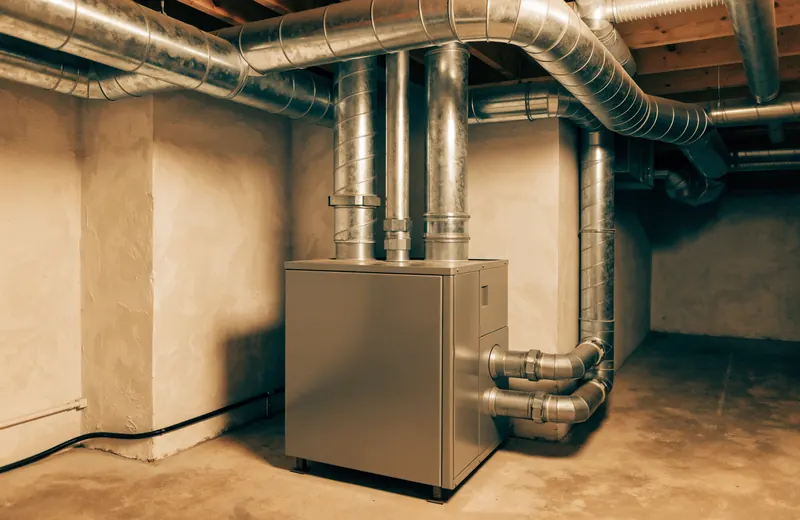
A modern gas furnace does not simply light when the thermostat asks. It runs a fixed sequence of checks, each one proving the last step worked before the next is allowed to happen, and it will shut itself down at any point where a check fails. Once you know the order, most furnace complaints sort themselves into two piles: the ones where a check is failing for a reason you can see, and the ones that need a technician.
The sequence
-
The thermostat calls for heat. Inside the thermostat, the R and W contacts close, which is the control board’s signal to start.
-
The draft inducer starts. Before the main burners ignite, a small fan, the inducer, clears out any gases left in the burner area and pulls air through the heat exchanger toward the vent.
-
The pressure switch proves draft. The pressure switch responds to the suction the inducer creates and tells the board the inducer is working. On Goodman’s control, the pre-purge period begins only once the pressure switch is detected closed. If the vent is blocked or the inducer is weak, the furnace stops here.
-
The igniter energizes. Most furnaces built in the last few decades use a hot surface igniter that glows orange when it is hot; others use a spark, or an intermittent pilot that is lit only when there is a call for heat. Carrier’s owner’s manual describes the inducer starting and the igniter glowing.
-
The gas valve opens and the burners light. On the Carrier example, after about 17 seconds of igniter warm-up the gas valve permits gas to flow to the main burners, where it is ignited.
-
The flame sensor proves flame. The flame sensor detects whether a flame is present in the combustion chamber. If it cannot detect one, it shuts off the gas supply. The igniter is de-energized as soon as flame is sensed.
-
The blower starts, after a delay. The burners heat the heat exchanger, a sealed metal chamber that absorbs the combustion heat and transfers it to the air circulating through the system without mixing the two. The house blower waits (roughly 25 to 45 seconds on the Carrier example, 30 seconds on the Goodman) so that the exchanger is warm before air moves across it and you are not blasted with cold air at startup.
-
The cycle ends. When the thermostat is satisfied the gas valve closes, the inducer runs a short post-purge (15 seconds on the Goodman), and the blower keeps running for an off-delay (90 seconds by default on the Goodman, adjustable from 30 to 180) to pull the remaining heat out of the exchanger.
The switches that stop it
A furnace is wrapped in safeties, and most no-heat calls are a safety doing its job.
- The high limit switch shuts the furnace down if it senses overheating. Trane’s troubleshooting names the common trigger: a clogged or dirty filter that disrupts airflow, so the furnace overheats and shuts down before a heating cycle is done. That is the short-cycling pattern.
- Manual-reset rollout switches near the burners trip on a high-temperature condition such as inadequate combustion air. A tripped manual-reset switch means something went wrong in the burner compartment; it is a reason to call a technician, not to keep resetting it.
- The pressure switch and flame sensor stop the sequence at steps 3 and 6, as above.
AFUE, in one paragraph
The efficiency number on a furnace is AFUE, annual fuel utilization efficiency: the ratio of the furnace’s annual heat output to the fuel energy it consumed. An AFUE of 90 percent means 90 percent of the energy in the fuel becomes heat for the home and the other 10 percent escapes up the chimney and elsewhere. DOE’s rough tiers: old natural-draft furnaces with a continuous pilot light ran 56 to 70 percent; mid-efficiency units with electronic ignition and an exhaust fan run 80 to 83 percent; condensing, sealed-combustion furnaces that wring extra heat from the flue gases in a second heat exchanger run 90 to 98.5 percent. The Federal Trade Commission requires new furnaces to display their AFUE. The current federal minimum for non-weatherized gas furnaces is 80 percent, in effect since November 2015; a 2023 DOE rule raises it to 95 percent for furnaces manufactured on or after December 18, 2028. (DOE was reported in 2026 to be weighing a petition to delay that date; check before you rely on it.)
Why the heat exchanger matters more than anything else
The heat exchanger is the wall between the fire and the air you breathe. DOE’s furnace guidance says leaking heat exchangers mix combustion gases with house air, and that combustion gases leaking into the house can cause carbon monoxide poisoning. Carbon monoxide is colorless and odorless. This is the main reason for an annual professional inspection: ENERGY STAR’s fall tune-up checks the gas connections, gas pressure, burner combustion and the heat exchanger, and CPSC’s standing advice is to have the heating system professionally inspected and serviced annually, with CO alarms on every level of the home and outside sleeping areas.
What you can check before you call
Carrier’s owner’s manual lists the homeowner checks, and they clear a surprising share of no-heat calls:
- Is the thermostat set above room temperature, and is HEAT mode selected?
- Is the furnace’s electrical power switch on? Has a breaker tripped? Is a fuse blown (there is one on the furnace control board)?
- Is the blower access door firmly in place? Furnaces will not run with the door off; the door switch is a safety, and it is never to be taped or wedged to run the furnace open.
- Is the gas shutoff valve open?
- Is the filter clean, and are the return grilles clear?
Two symptoms worth knowing: a furnace that starts and then shuts off after 2 to 5 seconds, over and over, often has a dirty or failing flame sensor; a blower that runs but delivers cold air often means ignition failed, and igniters are fragile parts that Carrier advises having a professional replace.
If you smell gas
Carrier’s instructions, and every gas utility’s: do not touch any electrical switch, do not use any phone in the building, leave immediately, and call the gas supplier from a neighbor’s phone. Nothing on this page applies until the gas company has cleared the house.
When to call a technician
Limit-switch faults, ignition problems, flame sensor cleaning or replacement, anything to do with the heat exchanger, and all gas and combustion checks are technician work. Lennox’s glossary says it directly: annual inspections and tune-ups by a licensed HVAC professional are critical, because cracks or corrosion in the exchanger can let carbon monoxide into the home. If the furnace has shut itself down on a safety more than once, stop resetting it and make the call.
Related
- Almanac: September, book the tune-up, January, if it was missed, October, before the first run
- How a furnace and AC filter works, the part behind most limit-switch trips
- Glossary: AFUE, heat exchanger, inducer, flame sensor, limit switch
References
- Service and Troubleshooting, 80% Single Stage Gas Furnaces (RS6621008). Goodman Manufacturing. https://hvacdirect.com/media/pdf/GM9S80%20GC9S80%20Service%20Manual.pdf
- Furnace Parts: Understanding the Components of a Furnace. Carrier. https://www.carrier.com/us/en/residential/hvac-resources/furnaces/furnace-parts/
- Gas Furnaces: What a Tech Needs to Know. HVAC School. https://www.hvacrschool.com/gas-furnaces-what-a-tech-needs-to-know/
- Owner's Manual, Induced Combustion Gas Furnace (OM58-132). Carrier. https://www.shareddocs.com/hvac/docs/1009/Public/01/OM58-132.pdf
- What is a Furnace Ignitor?. Carrier. https://www.carrier.com/us/en/residential/hvac-resources/furnaces/furnace-ignitor/
- Furnace Flame Sensor: What It Is and How to Fix It. Carrier. https://www.carrier.com/us/en/residential/hvac-resources/furnaces/furnace-flame-sensor/
- Furnace Short Cycling: Causes and Solutions. Trane. https://www.trane.com/residential/en/resources/troubleshooting/gas-furnaces/furnace-short-cycling/
- Furnaces and Boilers. U.S. Department of Energy, Energy Saver. https://www.energy.gov/node/374305
- Energy Conservation Standards for Consumer Furnaces, final rule (Dec. 18, 2023). Federal Register via GovInfo. https://www.govinfo.gov/content/pkg/FR-2023-12-18/html/2023-25514.htm
- Heat Exchanger (glossary). Lennox. https://www.lennox.com/residential/buyers-guide/guide-to-hvac/glossary/heat-exchanger
- Carbon Monoxide Questions and Answers. U.S. Consumer Product Safety Commission. https://www.cpsc.gov/Safety-Education/Safety-Education-Centers/Carbon-Monoxide-Information-Center/Carbon-Monoxide-Questions-and-Answers
- Maintenance Checklist. ENERGY STAR. https://www.energystar.gov/saveathome/heating-cooling/maintenance-checklist
Every fact and number on this page comes from one of the sources above, read during the writing of this page. Codes and standards vary by jurisdiction and edition; your local code and your equipment's manual control.