How it works: Carpentry
How wood moves with the seasons
Why the drawer sticks in August and the floor gaps in January
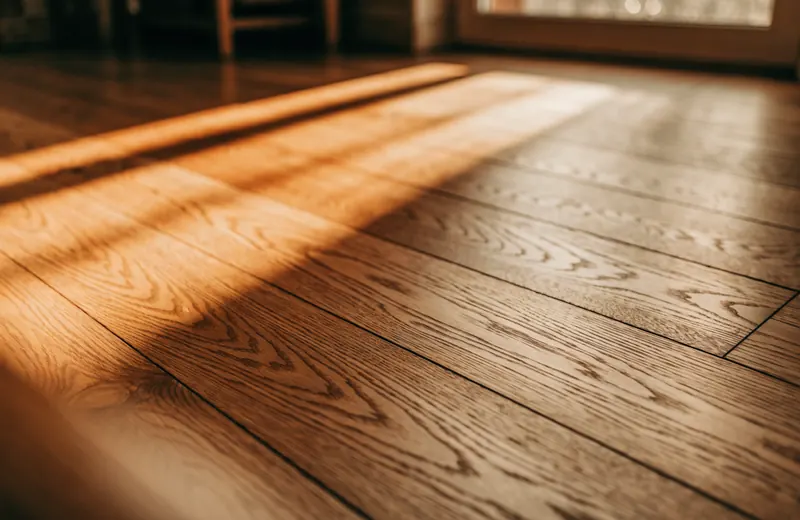
Wood is the one material in a house that keeps changing after it is installed. It is hygroscopic: as the USDA Forest Products Laboratory’s Wood Handbook puts it, wood takes on moisture from the surrounding environment and gives it back as the air dries. As it does, it changes size. Nearly every small seasonal mystery in a wood-framed, wood-trimmed, wood-floored house traces back to that one fact.
Moisture content and the fiber saturation point
Moisture content is the weight of water in a piece of wood expressed as a percentage of the wood’s oven-dry weight. Freshly cut wood can hold more water than wood substance. That water sits in two places: free water in the cell cavities, and bound water in the cell walls. As wood dries, the free water leaves first, and nothing much happens to the wood’s size. The point below which most wood properties start to change, the fiber saturation point, averages about 30 percent moisture content, varying by several points between species and pieces.
Below that point, the Handbook says, wood changes dimension as it gains moisture (swells) or loses moisture (shrinks), because the volume of the cell wall depends on the amount of bound water. All the movement you ever see in a house happens in that range, between 30 percent and bone dry.
Equilibrium with the room
Wood does not dry to zero. It settles at an equilibrium moisture content, the level at which it is neither gaining nor losing moisture, and that level depends on the relative humidity and temperature of the surrounding air. Humid August air pushes the equilibrium up; furnace-dried January air pulls it down. Purdue’s extension guide says it plainly: when the air is humid, wood adsorbs moisture and swells; when the air is dry, wood loses moisture and shrinks.
Paint, varnish and lacquer slow this exchange but, the Handbook notes, cannot prevent it. A finished door still moves; it just lags the weather by a few weeks.
Which way, and how much
Wood does not move equally in all directions. The Wood Handbook gives the pattern: it shrinks and swells most in the direction of the annual growth rings (tangentially), about half as much across the rings (radially), and only slightly along the grain, roughly 0.1 to 0.2 percent for most species. In practice: a board gets wider and narrower with the seasons, barely thicker and thinner, and essentially never longer or shorter. A flat-sawn floorboard, whose face runs along the rings, moves the most across its width; a quartersawn board, cut so the rings run through its thickness, moves about half as much and stays flatter.
Daily humidity swings barely register. The Handbook says changes from daily humidity variation are often small and of no consequence; it is the seasonal change, gradual as it is, that tends to be of more concern.
What that looks like in a house
Sticking doors and drawers. Purdue’s guide observes that drawers that move easily in the factory often stick tightly after desks are in service for some time. The same goes for a door that closed fine in February and rubs the jamb in June: the slab and the jamb both widened. See how a door hangs and why it sticks.
Gapping floors. The Handbook: cracks can develop in wood flooring if the material takes up moisture either before or after installation, then shrinks when the building is heated. The gaps that open in January close again in July. Do not fill them in winter; the filler will be squeezed out or crack the board edges when summer comes. The National Wood Flooring Association’s prevention advice is to hold the house between 60 and 80 F and 30 to 50 percent relative humidity year-round, which narrows the swing. Floors that lose moisture gap or split; floors that gain moisture cup, with the edges higher than the centers.
Trim joints that open. A miter at the corner of door casing is two boards moving across their width in different directions. The joint that was tight in October opens a hair in February, and closes again by summer.
Installing wood so it stays put
The Handbook’s rule is simple: no significant dimensional changes will occur if wood is fabricated or installed at a moisture content corresponding to the average conditions it will be exposed to. For interior woodwork, flooring, furniture and trim, its table gives a target of about 8 percent average in most of the United States (6 to 10 percent for individual pieces), about 6 percent in the dry Southwest, and about 11 percent in damp, warm coastal areas.
For flooring it gets specific: break open the bundles and expose all sides of the flooring to the air inside the structure, and increase the temperature about 15 F above the outdoor temperature for about three days before laying the floor. Wood delivered from a cold warehouse to a heated house in winter is at a different equilibrium than the room, and giving it those days is cheaper than refinishing a cupped floor. A moisture meter, a pin or pinless instrument that reads moisture content directly, takes the guessing out of it.
Related
- Almanac: February (winter gaps), June (summer swelling), September (acclimating for fall projects), November (humidity as the heat comes on)
- How a door hangs and why it sticks, How a wall is framed
- Glossary: moisture content, equilibrium moisture content, kiln-dried, plywood, nominal size
References
- Wood Handbook (FPL-GTR-282, 2021), Chapter 4: Moisture Relations and Physical Properties of Wood. USDA Forest Service, Forest Products Laboratory. https://www.fpl.fs.usda.gov/documnts/fplgtr/fplgtr282/chapter_04_fpl_gtr282.pdf
- Wood Handbook (FPL-GTR-282, 2021), Chapter 13: Drying and Control of Moisture Content and Dimensional Changes. USDA Forest Service, Forest Products Laboratory. https://www.fpl.fs.usda.gov/documnts/fplgtr/fplgtr282/chapter_13_fpl_gtr282.pdf
- The Shrinking and Swelling of Wood and Its Effect on Furniture (FNR-163). Purdue University Forestry and Natural Resources. https://www.extension.purdue.edu/extmedia/FNR/FNR-163.pdf
- Problem Prevention. National Wood Flooring Association. https://woodfloors.org/problem-prevention/
Every fact and number on this page comes from one of the sources above, read during the writing of this page. Codes and standards vary by jurisdiction and edition; your local code and your equipment's manual control.