How it works: Electrical
How a GFCI trips
The outlet that counts electrons in and out, and cuts the power when they do not match
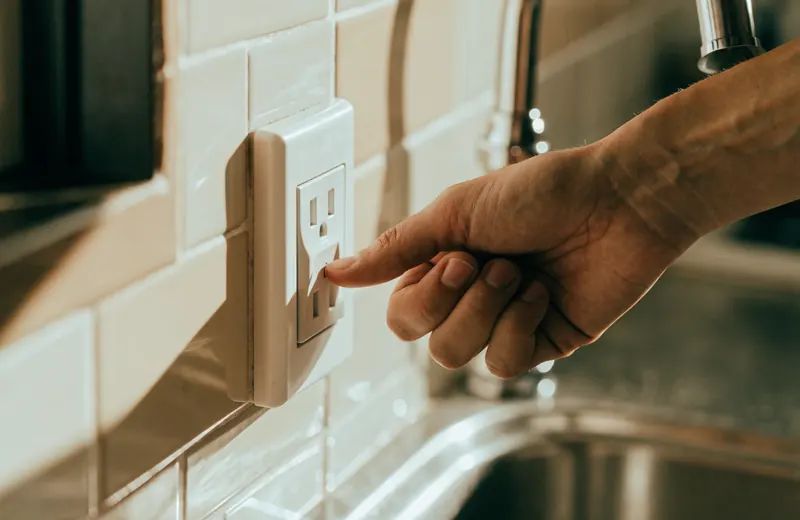
A ground-fault circuit interrupter, the outlet with the TEST and RESET buttons in the bathroom and kitchen, is doing arithmetic all day. It measures the current going out to whatever is plugged in and the current coming back, and as long as the two match it does nothing. The moment they differ by a few thousandths of an ampere, it opens the circuit, because that missing current is going somewhere it should not, and the somewhere may be a person.
What it measures
Current in a circuit is a loop. On a normal circuit, every bit of current that leaves the panel on the hot wire comes back on the neutral. OSHA’s description of the device: it works by comparing the amount of current going to and returning from equipment along the circuit conductors. If a hair dryer falls in the sink, or a cracked tool casing becomes live and a hand touches it, some of the current finds a path to ground through water or a body instead of returning on the neutral. The outgoing and returning currents no longer match.
How small a mismatch, and how fast: CPSC puts the trip point at a difference as little as 0.006 amperes (six thousandths), interrupting power faster than a blink of an eye. Virginia Tech’s safety office gives the same figure in different units: if the current differs by more than 5 milliamperes between the hot and neutral wires, the GFCI opens the circuit in approximately 1/40 of a second. For comparison, the breaker in your panel is rated in whole amperes, 15 or 20, and never notices a fault that small.
What it is not
A GFCI is not an overcurrent device like a fuse or circuit breaker. Breakers protect wiring and equipment from overheating and fire; as OSHA’s training guide says, they may or may not protect you from shock. The GFCI exists for the shock.
It also has a blind spot. OSHA: a GFCI will not protect you from line contact hazards, such as a person holding two hot wires, or a hot and a neutral in each hand. In those cases the current goes out and comes back through the person, the totals still match, and the device sees nothing wrong. It protects against ground faults, which are the common shock hazard, not against every possible one.
Three kinds, and the one that protects its neighbors
GFCIs come as circuit breakers in the panel, as receptacles that replace a standard outlet, and as portable units. The receptacle type fits a standard outlet box and protects whatever is plugged into it and, as CPSC puts it, other outlets further downstream in the branch circuit.
That downstream protection is why GFCIs confuse people. A GFCI receptacle has two pairs of terminals: LINE, which brings power in from the panel, and LOAD, which sends power on to other receptacles on the circuit. Leviton’s instruction sheet shows it: placing the GFCI in the first position protects the load-side receptacles after it. So a dead outlet in the garage, on the patio, or in the second bathroom is very often a tripped GFCI somewhere else, and the first place to look is every GFCI in the house.
Where the code requires them
ESFI’s summary of the National Electrical Code: GFCIs are required in all kitchens, bathrooms, garages, basements, crawl spaces and outdoors. The requirements arrived in stages, which is why older houses have gaps. CPSC’s timeline: outdoors since 1973, bathrooms since 1975, kitchens since 1987. A house with original 1970s wiring may have a GFCI outside and none at the kitchen counter.
Testing it
Both CPSC and the manufacturers say monthly. The test: press the TEST button, which should click the device off and kill power to the outlet and anything downstream of it, then press RESET. CPSC’s version adds a lamp. Plug a lamp into the outlet, turn it on, press TEST. Did the light go out? If not, the GFCI is not working or has not been correctly installed. The Almanac keeps this on the every-month list, and gives it a second look in May (National Electrical Safety Month) and July before the outdoor outlets get their summer workout.
When it will not reset
Many GFCIs contain a lockout that prevents RESET under two conditions Leviton lists: there is no power being supplied to the GFCI, or the LINE and LOAD leads are reversed. So a GFCI that refuses to reset after a storm is often simply downstream of a tripped breaker; check the panel first. Unplug everything on the circuit and try again, because an appliance with an ongoing ground fault will trip it the moment it resets. Leviton’s reset guide ends where this page does: if your GFCI still will not reset after following these steps, it may be time to call a licensed electrician.
When to call an electrician
A GFCI that trips with nothing plugged in, one that will not reset with the breaker on, one that passes the TEST button but not the lamp test, or any outlet that is warm to the touch or smells of heat: these are electrician calls. So is adding GFCI protection to a kitchen or bath that never had it. Where local rules allow homeowners to work on their own wiring (many places require a permit or a licensed electrician even for a receptacle swap, so check first), replacing a receptacle is within reach of a careful homeowner with the breaker off and a tester proving the box dead. But the LINE and LOAD wiring is exactly the detail that gets reversed, a GFCI wired backwards will not reset or will not protect, and when in doubt this is the electrician’s job too.
Related
- Almanac: every month (standing list), May, July, December, outdoor decorations
- How a circuit breaker trips, and what an AFCI adds
- Glossary: GFCI, ground, hot wire, neutral, tamper-resistant receptacle
References
- Construction eTool: Electrical Incidents, Ground-Fault Circuit Interrupters (GFCI). U.S. Occupational Safety and Health Administration. https://www.osha.gov/etools/construction/electrical-incidents/ground-fault-circuit-interrupters
- Ground-Fault Circuit-Interrupters. Virginia Tech Environmental Health and Safety. https://ehs.vt.edu/programs/occupational-safety/electrical-safety/ground-fault-circuit-interrupters.html
- GFCIs Fact Sheet (Document 099). U.S. Consumer Product Safety Commission. https://www.cpsc.gov/s3fs-public/099_0.pdf
- Construction Focus Four: Electrocution Hazards (Instructor Guide). OSHA Training Institute. https://www.osha.gov/sites/default/files/electr_ig.pdf
- Installing and Testing a GFCI Receptacle (instruction leaflet). Leviton. https://leviton.com/content/dam/leviton/residential/product_documents/instruction_sheet/LC_MO_PDF_EL_7591_INSTRUCTION.pdf
- Ground Fault Circuit Interrupters (GFCI). Electrical Safety Foundation International. https://www.esfi.org/ground-fault-circuit-interrupters-gfci/
- How to Reset a GFCI Outlet After Lockout. Leviton. https://leviton.com/support/literature/blogs/how-to-reset-a-gfci-outlet-after-lockout--a-step-by-step-guide
Every fact and number on this page comes from one of the sources above, read during the writing of this page. Codes and standards vary by jurisdiction and edition; your local code and your equipment's manual control.