How it works: Electrical
How power gets into and around a house
From the transformer on the pole to the outlet behind the couch
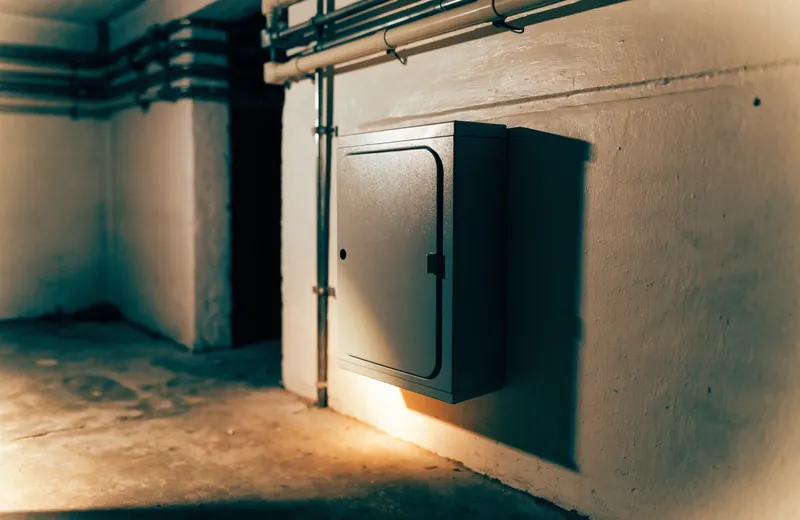
Electricity reaches a house by a path that has not changed much in a century, and most of it is visible from the yard: wires from a transformer, a meter on the wall, a gray panel in the basement or garage. Knowing the path explains why a dryer outlet has four slots, why the panel has one big breaker above all the small ones, and why there is a green or bare wire in every box.
From the transformer to the house
Power plants push electricity across high-voltage transmission lines, and transformers at substations step the voltage down for the distribution lines that run along streets. The last transformer in the chain, the can on the pole or the green box on the lawn, converts the distribution line’s high voltage to 240 volts for the typical residential customer.
From that transformer a service wire runs to the house. Overhead, it is the service drop, and it connects to the house at the weatherhead, the hooded fitting at the top of the mast. Underground, the buried conductors are the service lateral, running to a terminal box or the meter. Who owns which piece varies by utility; FirstEnergy’s Pennsylvania guide, for instance, has the company owning the drop and the residential lateral while the customer supplies the meter socket.
The meter and the main breaker
The meter plugs into the meter base on the house wall and measures how much electrical energy the home uses. From the meter, a service entrance cable carries power to the electrical panel, where it enters the home’s wiring.
Code requires a way to disconnect both incoming hot conductors where they enter the building. The electrical code calls this the main service disconnect, and it is usually the main circuit breaker at the top of the panel. Everything in the house is downstream of it. Know where it is before you need it.
Two hot legs and a neutral
Standard home service is three wires. Michigan State’s tech note calls it a single-phase, 120/240-volt, 3-wire system. Two of the wires are ungrounded, energized conductors, frequently called hot leg A and leg B; the third, the common wire, is the neutral. Between either hot leg and the neutral there are 120 volts, and between the two hot legs there are 240.
Inside the panel each hot leg feeds its own bus bar. A single-pole breaker attaches to just one of the energized bus bars and powers a 120-volt circuit: lights, ordinary outlets, the refrigerator. A two-pole breaker spans both bus bars and powers a load that needs 240 volts: larger appliances such as clothes dryers and electric ranges. That is why the dryer plug has extra blades; it carries both hot legs plus the neutral and ground.
From the breakers, branch circuits provide electricity to receptacle outlets, lights and appliances throughout the home.
What the ground is for
Electrical codes require the common wire, the neutral, to be grounded to the earth, typically with a ground rod driven into the earth to a depth of not less than 8 feet, or a connection to the footing’s reinforcing steel or a metal water pipe: the grounding electrode.
The bare or green wire that runs with every circuit is the equipment grounding conductor, and OSHA explains its purpose in one sentence: grounding a tool or electrical system means intentionally creating a low-resistance path to the earth, so that if a malfunction causes the metal frame of a tool to become energized, the equipment ground provides another path for the current. Without it, the other path is you. The ground wire normally carries nothing at all; it is there for the day something fails, which is also when a GFCI or a breaker gets the chance to do its job.
What never to open
CPSC’s home wiring guide draws the line in capital letters: do not remove the service-panel cover; this is a job for a qualified electrician. Behind that cover, the lugs where the service conductors land are live even with the main breaker off, because the main breaker is downstream of them; only the utility can de-energize them, by pulling the meter. The meter and everything on the utility side of it are the utility’s equipment, not yours to open.
What is yours: the breaker handles on the front of the panel, the labels on the door (keep them accurate), the space in front of the panel (keep it clear), cord-connected equipment, and, where local rules allow homeowner electrical work, the outlets and switches in the rooms, with the breaker off and proven off with a tester before any cover comes off.
Warning signs
From the same CPSC guide: lights that dim often, parts of the system that are hot rather than merely warm, and the odor of burned or overheated wires. Add to that a breaker that trips repeatedly, outlets that no longer grip a plug, and any buzzing from the panel. Each one is an electrician call, and together they are the reason an older house benefits from a licensed electrician’s inspection even when nothing has failed yet.
Related
- Almanac: September, National Preparedness Month (know where the main breaker and the shutoffs are)
- How a GFCI trips, How a circuit breaker trips
- Glossary: service drop, meter base, main breaker, bus bar, hot wire, neutral, ground, subpanel
References
- Delivery to consumers. U.S. Energy Information Administration. https://www.eia.gov/energyexplained/electricity/delivery-to-consumers.php
- Electrical Tech Note 219: Single-Phase, 120/240 Volt, 3-Wire Electrical System. Michigan State University, Biosystems and Agricultural Engineering. https://www.maec.msu.edu/download_file/view/f38bdfda-6e58-4ee2-8146-5e3ae5989243/303
- How Power is Delivered to Your Home. Central Alabama Electric Cooperative. https://caec.coop/electric-service/how-power-is-delivered-to-your-home/
- Customer Guide for Electric Service, Pennsylvania (2021). FirstEnergy. https://www.firstenergycorp.com/content/dam/customer/service%20requests/files/Customer-Guide-for-Electric-Service-PA.pdf
- CPSC Guide to Home Wiring Hazards (Publication 518). U.S. Consumer Product Safety Commission. https://www.cpsc.gov/s3fs-public/518.pdf
- Construction eTool: Electrical Incidents, Grounding. U.S. Occupational Safety and Health Administration. https://www.osha.gov/etools/construction/electrical-incidents/grounding
- Inspecting the Main Electrical Panelboard During a Home Inspection. InterNACHI. https://www.nachi.org/inspect-main-electric-panelboard.htm
Every fact and number on this page comes from one of the sources above, read during the writing of this page. Codes and standards vary by jurisdiction and edition; your local code and your equipment's manual control.