How it works: Plumbing
How a thermostatic mixing valve works
Store it hot, serve it warm: the wax element, the piston between two seats, and why the valve at the tank is not the valve at the tub
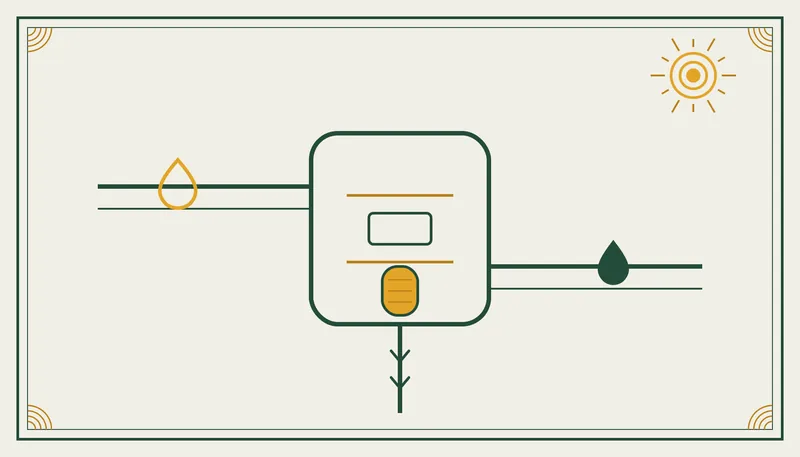
Store it hot, serve it warm. That is the bargain a thermostatic mixing valve makes, and it is an old one in big buildings that has moved into houses. Caleffi’s sheet for its 5213 valve says that to guard against Legionella the hot water must be stored at a temperature of at least 140 F. The Consumer Product Safety Commission says a six second exposure to 140 F water will burn, and urges everyone to lower their water heaters to 120 F. A mixing valve on the heater’s hot outlet lets the tank keep the first number while the taps get something closer to the second.
Inside the valve
Hot water comes in one port, cold water in another, and the blend leaves by a third. Caleffi describes a thermostatic sensor fully immersed in the mixed water outlet tube, and a piston sliding in a cylinder between the hot and cold passages. Watts calls the element in its LFMMV a solid wax hydraulic principle thermostat and says the thermostat controls both hot and cold water. In Caleffi’s words, the element contracts or expands, moving the part that controls the flow of hot or cold water at the inlet.
The trick is where the element sits. It does not read the hot pipe or the cold pipe; it reads the water that has already been mixed. If the blend runs warm, the element expands and moves the piston to close down the hot side and open the cold. If the blend runs cool, the element contracts and the piston moves the other way. Caleffi’s 5213 sheet puts it as an element that expands or contracts and continuously establishes the correct proportion of hot and cold water. Caleffi says the internal element reacts automatically to restore the set temperature at the outlet. Caleffi ties that reaction to changes in the inlet temperatures or pressures, which covers a heater that recovers hotter or cooler, or cold water coming in colder in February than in August.
When a supply fails
The other half of the job is what happens when one supply quits. Caleffi says that if either the hot or cold supply fails on its 5213, the piston will close the opposite inlet; on its AngleMix 520 the valve will quickly close the hot inlet port to prevent the delivery of unsafe hot water. Resideo says its AMX valve, if cold water is shut off, reduces the mixed flow rate in seconds.
That shutoff has a condition in the fine print: the hot water has to be hot enough above the setting for the element to tell the difference. Caleffi’s 520 needs a minimum difference of 27 F between the hot inlet and the mixed outlet for its thermal shutoff in its ASSE 1070 setup and 18 F in its ASSE 1017 setup; Resideo lists a minimum 10 F difference between hot and mix on the AMX. Even then, Watts puts it plainly on the LFMMV sheet: mechanical valves are not fail-safe, and periodic verification of the outlet water temperature is required.
The numbers on the sheet
The spec sheets carry four numbers worth reading before a valve goes in.
- Accuracy. Watts gives its LFMMV a range of 80 to 120 F and accuracy within plus or minus 3 F; Caleffi’s 5213 holds plus or minus 3 F over 85 to 120 F; Cash Acme’s HG135 holds plus or minus 5 F as long as neither supply pressure varies by more than 20 percent.
- Minimum flow. Watts, Caleffi and Resideo each list 0.5 gallon a minute (Caleffi calls it the minimum flow rate for stable operation); Cash Acme lists 0.25 gallon a minute on the HG135.
- Approach temperature. A mixing valve can only mix down: the blend can never be hotter than the hot that comes in. Watts gives an approach temperature of 5 F above set point on the LFMMV, and on its LFUSG says the hot supply must be at least 5 F higher than the valve’s maximum set point. Cash Acme asks for at least 27 F on the HG135. The makers do not agree, so the sheet that came with the valve is the one to follow. The common mistake is a tank turned down to 120 F with the valve set at 120 F: the hot supply is below every margin the makers above ask for, so the valve cannot hold its setting and the thermal shutoff margin is gone.
- Pressure. Caleffi’s 5213 tolerates a 6 to 1 imbalance between hot and cold supply pressures, while its 520 asks for 2 to 1 for optimal performance; Watts lists a 25 percent maximum differential between the supplies on the LFMMV-HTK.
Then there are the check valves. A mixing valve ties the hot and cold piping together, and without a one-way valve on each inlet, water can cross from one side to the other. Caleffi says its 5213 has check valves on the inlets to prevent cross-connections, and that under ASSE 1070 check valves are required on the hot and cold inlets of its 520. Watts says check valves are a requirement for compliance with ASSE 1017 applications.
Which standard, which job
The single most useful thing to know about a mixing valve is the number of the standard on its label, because each one is listed for a different place in the house.
- ASSE 1017 is the valve at the water heater. The ASSE guidelines say these devices shall be installed at or near the outlet of the hot water source only, that used alone they do not provide thermal shock protection or adequate scald protection, and that further mixing downstream is allowed to provide final temperature control.
- ASSE 1070 is the valve at the fixture, under a sink or ahead of a tub. The guidelines say it can be adjusted up to a maximum of 120 F and provides scald protection only, not thermal shock protection.
- ASSE 1016 is the shower valve itself, installed at an individual shower or tub and shower, and the guidelines say it provides both scald and thermal shock protection. The pressure-balance shower valve is one kind.
- ASSE 1069 covers devices where the user does not have access to the temperature adjustment, designed to be the final temperature control.
Here is the mistake the standards are written to stop: a homeowner with a 1017 valve at the tank who takes the bathtub to be protected. Watts’s LFMMV sheet says a 1017 device cannot be used by itself to control final temperature at fixtures where ASSE 1016 or 1070 devices are required, and that such use may result in severe bodily injury or death. Code backs this at the tub: section 409.4 of the California Plumbing Code limits the hot water discharging from a bathtub or whirlpool bathtub filler to 120 F. Not every maker draws the line as hard; Resideo’s AM-1 guide says that valve may supply tubs and showers. Your local code and inspector decide which listing a fixture needs.
The payoff for doing it right is capacity. Watts says its LFMMV-HTK kit lets the tank be set at a higher temperature to minimize Legionella and other water-borne bacteria, and that it increases hot water capacity from the tank by as much as 133 percent; that figure is the top of its table for a 40 gallon heater, which starts at 27 percent.
Setting it and keeping it
A valve is set against a thermometer, never against the numbers printed on the cap. Watts’s LFMMV-HTK instructions say to turn on the hot water at the nearest outlet the valve supplies and to measure with a thermometer; its LF1170 instructions run the water at least 2 minutes with the thermometer in the stream, then lift the cap 1/4 inch to turn the adjuster, lower it and tighten the screw. Cash Acme runs the nearest outlet at 1.5 gallons a minute or more for at least a minute before reading, then replaces the cap to deter tampering. Resideo’s AM-1 guide says the discharge temperature is to be set and locked by its instructions, with a thermometer at the faucet outlet.
Position matters too. Watts’s LF1170 instructions put the valve at or near the water heater with its hot inlet 8 to 12 inches below the hot water supply feed, which Watts calls a trap.
The wear is mostly hard water. Resideo says scale deposits can cause binding of internal parts in extreme cases, and for its AMX it gives soaking the valve in vinegar for 24 hours to remove calcium. Watts calls for maintenance at least once a year or more as conditions warrant. Cash Acme says the strainers must be kept clean, and gives the tell to watch for: an outlet temperature that has drifted more than 5 F from the temperature it was commissioned at means the valve needs attention.
Homeowner or technician
The owner’s part is reading, not turning. Once a year, run the hot tap nearest the valve until the temperature stops changing, read it with a kitchen or water thermometer, and compare it with the number recorded when the valve was set, or with last year’s if that is all you have. Leave the cap alone. If the reading has moved more than 5 F, which is the drift Cash Acme treats as a fault, or if any tap the valve feeds runs hotter than 120 F, the temperature at which Resideo warns of serious injury, call a plumber.
The adjusting is technician work. Watts says the LFMMV-HTK must be installed by a licensed contractor in accordance with local codes, and that the LFUSG needs periodic inspection and yearly maintenance by a licensed contractor; Resideo says the AM-1 temperature setting should be done by a licensed contractor per local code. Watts’s LFUSG instructions also warn that tampering with a limit stop in any way may result in scalding temperatures and serious bodily harm or death, and Resideo’s guide states that water above 120 F can cause serious injury. Cleaning a scaled valve, replacing its element or check valves, and choosing between a 1017 and a 1070 valve for a tub all belong with the plumber, along with the water heater’s own relief valve, which no mixing valve replaces.
Related
- How a tank water heater works covers the 120 F and 140 F settings and why the tank runs hot.
- How a pressure-balance shower valve works covers the ASSE 1016 valve at the shower.
- Almanac: February, the water heater’s annual check
- Glossary: thermostatic mixing valve, approach temperature, thermostatic valve, check valve, TPR valve
References
- TubMixer 5213 Series Thermostatic Mixing Valve (01092 NA). Caleffi. https://www.caleffi.com/sites/default/files/media/external-file/01092_NA.pdf
- AngleMix DL 520 Series Thermostatic Mixing Valve (01420 NA). Caleffi. https://www.caleffi.com/sites/default/files/media/external-file/01420_NA.pdf
- Thermostatic mixing valves for low-temperature applications (H0016550). Caleffi. https://www.caleffi.com/sites/default/files/media/external-file/H0016550.pdf
- Series LFMMV Thermostatic Mixing Valve, specification sheet ES-LFMMV. Watts. https://watts.com/dfsmedia/0533dbba17714b1ab581ab07a4cbb521/20414-source/es-lfmmv-pdf
- LFMMV-HTK Hot Water Tank Kit, installation instructions IS-LFMMV-HTK. Watts. https://watts.ca/dfsmedia/0533dbba17714b1ab581ab07a4cbb521/21565-source/2915187-pdf
- LFMMV-HTK Hot Water Tank Kit, specification sheet ES-LFMMV-HTK. Watts. https://watts.ca/dfsmedia/0533dbba17714b1ab581ab07a4cbb521/21566-source/es-lfmmv-htk-pdf
- Series LF1170 and LFL1170 Hot Water Temperature Control Valves, installation instructions. Watts (PDF hosted by SupplyHouse). https://s3.amazonaws.com/s3.supplyhouse.com/product_files/0559107-install.pdf
- Series LFUSG-B Point-of-Use Thermostatic Mixing Valve, installation instructions. Watts. https://www.watts.com/dfsmedia/0533dbba17714b1ab581ab07a4cbb521/662450-source/639198034860000000/rp-is-lfusg-cs-2625.pdf
- Thermostatic Mixing Valves. Watts. https://www.watts.com/resources/references-tools/thermostatic-mixing-valves
- AM-1 Series Mixing Valve, installation guide. Resideo (PDF hosted by Industrial Stores). https://www.industrialstores.com/media/industrialstores/product/attachments/Resideo-AM-1-Series-Mixing-Valve-Installation-Guide-3.pdf
- AMX Series DirectConnect Mixing Valve, installation guide. Resideo (PDF hosted by Industrial Stores). https://www.industrialstores.com/media/industrialstores/product/attachments/Resideo-AMX-Series-DirectConnect-Installation-Guide-5.pdf
- Heatguard HG135 Thermostatic Mixing Valve, installation and maintenance manual. Cash Acme (PDF hosted by Consolidated Supply). https://res.cloudinary.com/consolidated-supply/resource/raw/cash_acme_25687_manual.pdf
- Guidelines for Temperature Control Devices. ASSE International (PDF hosted by IAPMO). https://iapmo.org/media/pbfltxqk/asse_guidelines_for_temp_control_devices.pdf
- California Plumbing Code, Chapter 4: Showers and Bathtubs (sections 408 and 409). GoCodeBook (California Plumbing Code text). https://gocodebook.com/us/california/california-plumbing-code/plumbing-fixtures-and-fixture-fittings/fixtures-by-type-toilets-lavs-showers-sinks/showers-and-bathtubs
- Avoiding Tap Water Scalds (Document 5098). U.S. Consumer Product Safety Commission. https://www.cpsc.gov/s3fs-public/5098-Tap-Water-Scalds.pdf
Every fact and number on this page comes from one of the sources above, read during the writing of this page. Codes and standards vary by jurisdiction and edition; your local code and your equipment's manual control.